
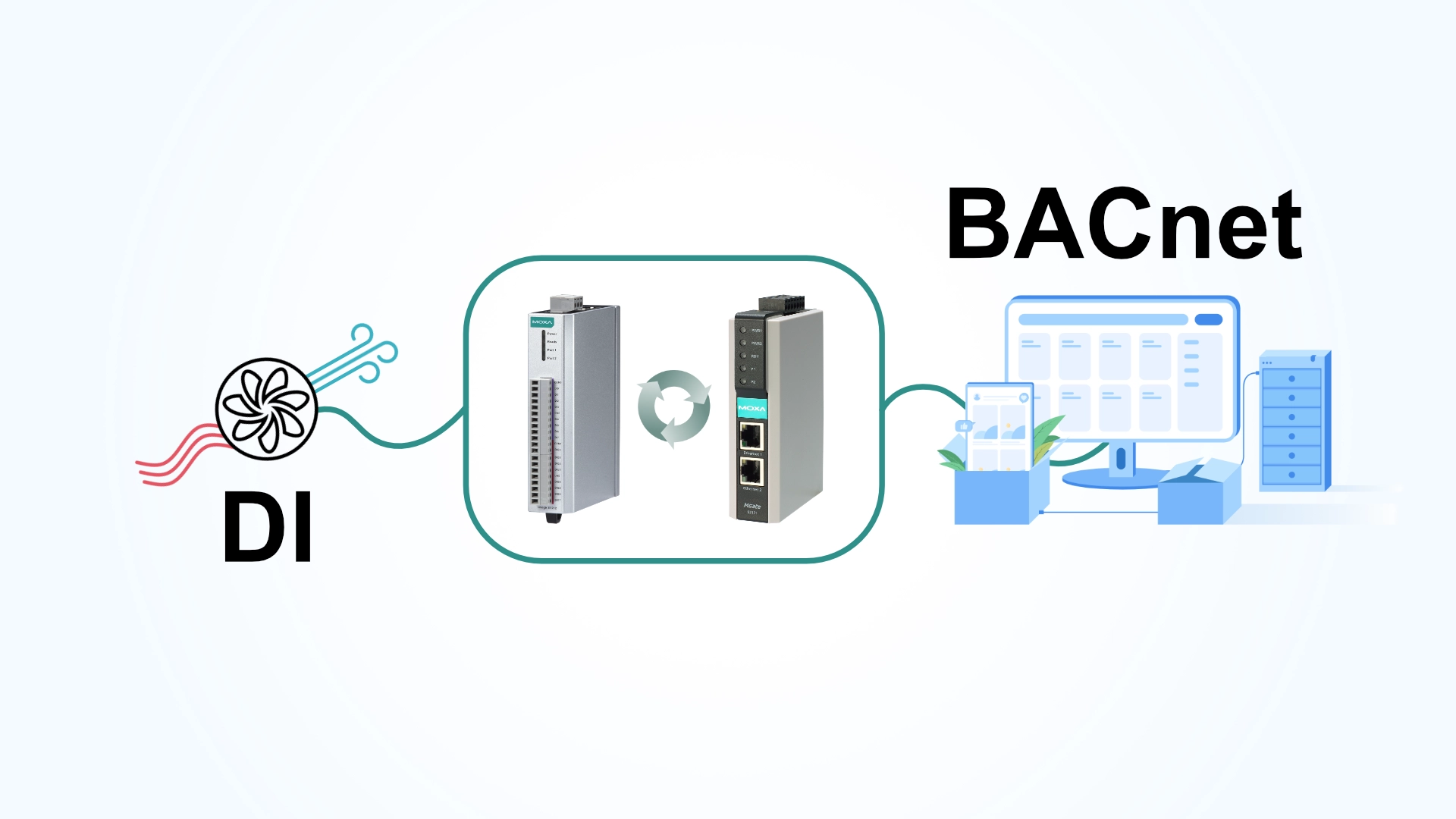
This is a success story of APulsar Technologies in the data center vertical market. From this case study, you will find out how APulsar helped the customer connect their HVAC system to an existing BMS using the MOXA ioLogik E1210 and MGate 5217:
Project Overview
This project is the result of APulsar Technologies’ collaboration with a hyperscale data centre in Malaysia. The customer needed to integrate their cooling tower equipment into their existing Building Management System (BMS). APulsar’s role was to help create a bridge between very specific HVAC equipment and the software. The project was completed in April 2025.
Customer Environment
A hyperscale data centre operating a cooling tower system required seamless integration with its Building Management System (BMS) for equipment status monitoring.
Objective
Enable the BMS (BACnet/IP) to read multiple dry-contact status signals from the cooling tower equipment in real time.
Key Requirements
- Connect dry-contact DI signals to the BMS.
- Convert data to BACnet/IP format.
- Maintain high reliability suitable for datacenter operations.
APulsar's Scope
- Industrial gateway and I/O hardware.
- On-site testing, configuration, and protocol mapping.
- Integration and verification with the BMS team.
Challenges Customer Met
The main challenge for the customer was the dual limitation of both the BMS and the HVAC equipment. Both were bound to send or receive data in a specific format, so it was not possible to connect them without an agent-like solution in between:
Technical Challenges
- The cooling tower equipment only provided dry-contact DI signals.
- The BMS operated strictly on BACnet/IP and could not natively read Modbus or raw DI.
- The customer required non-intrusive integration without modifying the existing cooling tower controls.
- The system had to follow datacenter reliability expectations (no single point of failure, stable data updates).
Business Challenges
- Vendor-specific proprietary BMS I/O modules were costly.
- The project timeline required a fast, stable, and field-proven data acquisition method.
Solution APulsar Provided
For this project, APulsar handled the full-scale scope of work: from preliminary research to product shipment and configuration. As a result, we delivered a complete, scalable, and engineered solution combining hardware and services:
Hardware Delivered
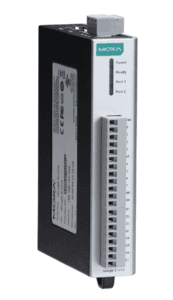
- MOXA ioLogik E1210 for DI signal acquisition.
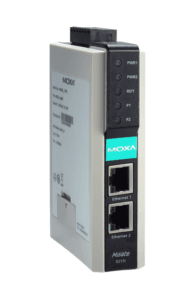
- MOXA MGate 5217 for Modbus TCP to BACnet/IP protocol conversion.
Services Provided
- Site assessment and signal identification.
- ioLogik E1210 channel configuration (DI modes, debounce settings).
- Modbus register mapping and verification.
- MGate 5217 BACnet object configuration (BI objects, device instance, object naming).
- Coordination with the Johnson Controls BMS engineer to integrate objects.
- On-site FAT/SAT testing and commissioning.
- Documentation of the final point list and network diagram.
System Diagram
The logic behind our solution is as follows:
- The HVAC equipment (on the left) is accessible via standard dry-contact signals.
- The MOXA ioLogik E1210 is responsible for collecting the data from the HVAC unit using its DI (Digital Inputs). The entire module is polled via Modbus TCP (Modbus TCP Slave mode).
- The MOXA MGate 5217 acts as an agent between the Modbus and BACnet protocols. It polls the data from the ioLogik E1210 via Modbus TCP (Modbus TCP Master mode) from the left part of the diagram and communicates with the BMS via the BACnet protocol.
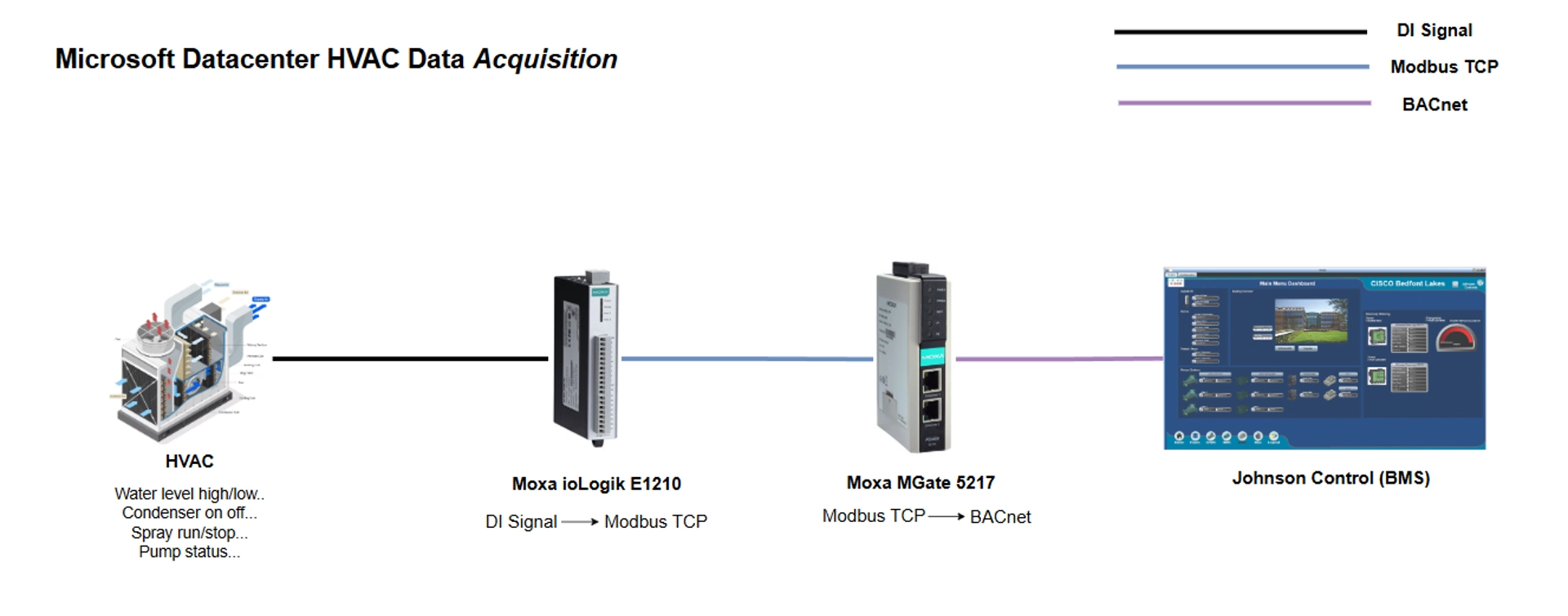
A system diagram of the hyperscale data centre HVAC Data Acquisition system using MOXA ioLogik E1210 & MGate 5217 for Remote I/O and Modbus TCP to BACnet conversion.
Results and Benefits
The elegance of this solution lies in how each piece of equipment remains in its native environment: the BMS interfaces directly with a BACnet device, the ioLogik and MGate modules communicate via Modbus, and the HVAC simply outputs standard dry-contact signals. As a result, we built a transparent data bridge from the BMS straight to the cooling tower equipment. The MOXA hardware operates completely seamlessly within the system.
Integration Results
- Successful real-time monitoring of all cooling tower status points via BACnet/IP.
Key Benefits Delivered
- Cost-effective: Avoided the purchase of proprietary BMS I/O modules.
- Scalable: The architecture can be easily extended to additional equipment.
- Reliable: Stable Modbus TCP and BACnet/IP communication designed for datacenter environments.
- Fast Deployment: Short engineering time and minimal wiring changes.
Get in touch!
The APulsar team hopes that this article has been insightful for you. Anytime you need advice, assistance, or technical support — just contact us.
And if you would like to see more useful guides like this one, don’t forget to subscribe to our newsletter below!

This is the heading
Lorem ipsum dolor sit amet, consectetur adipiscing elit. Ut elit tellus, luctus nec ullamcorper mattis, pulvinar dapibus leo.