
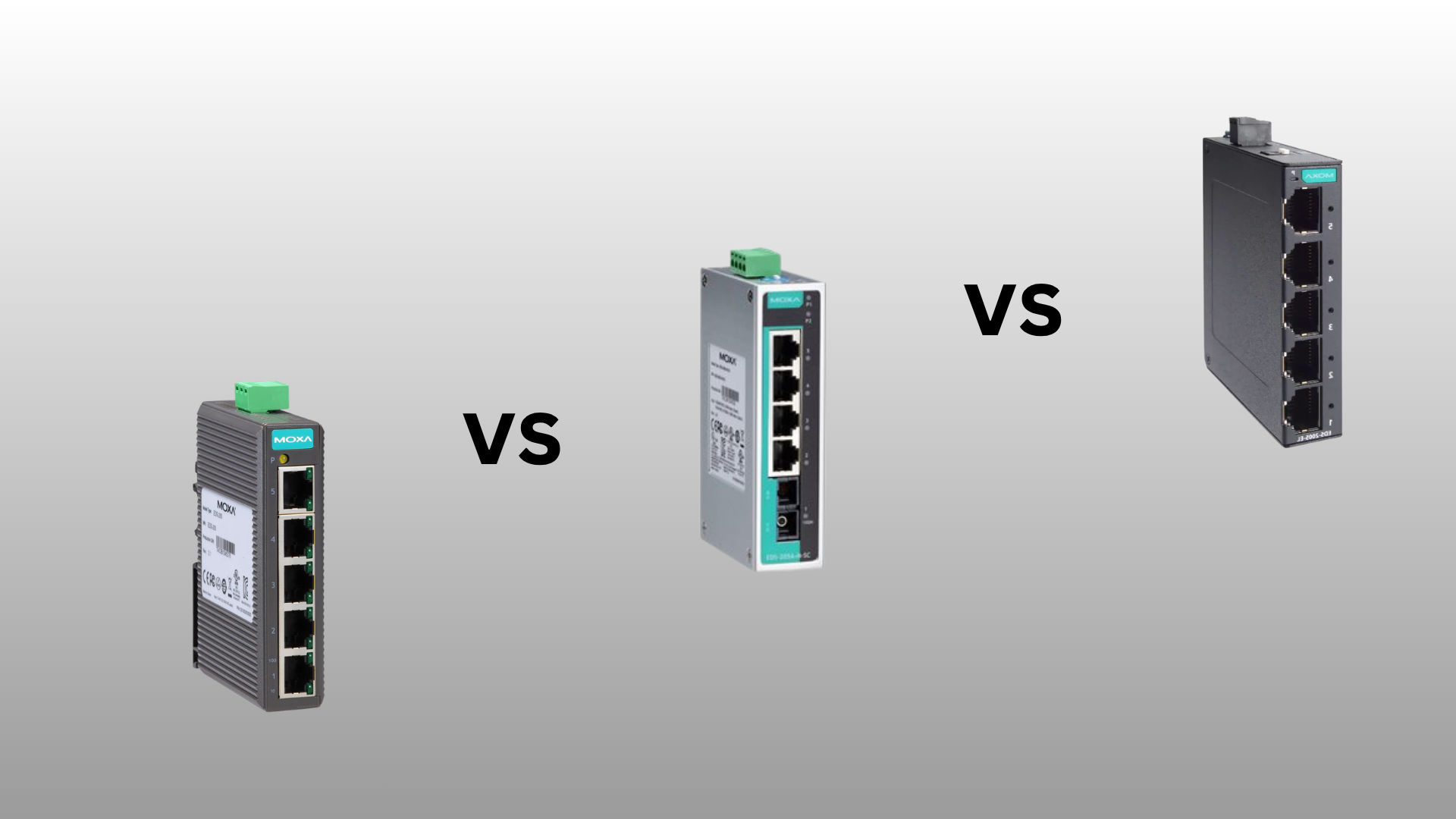
Note: This comparative review focuses strictly on 100 Mbps (Fast Ethernet) models—including the classic EDS-200, the rugged EDS-200A, and the next-generation EDS-2000 series. Moxa’s Gigabit “G” models (such as the EDS-G2000 series) will be covered in a dedicated future guide.
In the fast-moving world of industrial automation, the devices that connect our machines are just as critical as the machinery itself. For nearly two decades, control engineers and panel builders have relied on simple, unmanaged switches to act as the “plug-and-play” backbone of factory floor communication.
This guide explores the physical and functional evolution of Moxa’s entry-level unmanaged networking line, tracking how these essential devices have adapted to meet the shrinking space and growing traffic demands of modern control cabinets.
The Lineage: A Story of Generational Progress
To appreciate Moxa’s engineering journey and make an informed procurement decision, it helps to view these three series as successive milestones in industrial networking:
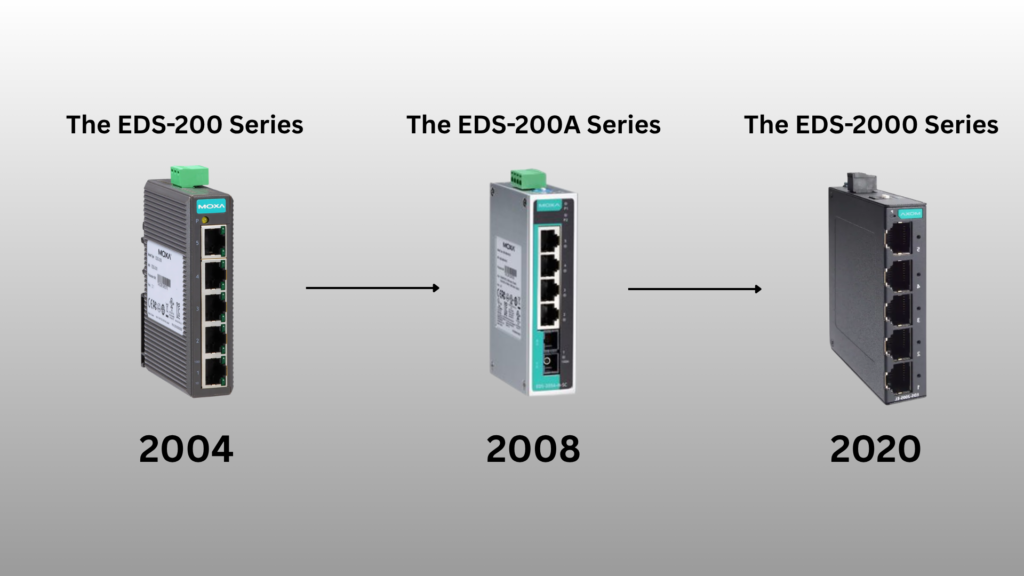
- The EDS-200 Series (The Classic Pioneer): Released in 2004, this is the entry-level workhorse that started it all. Over the past two decades, it has earned a legendary reputation for rock-solid reliability. While it remains active in legacy panels today, its classic footprint is gradually giving way to more space-efficient designs.
- The EDS-200A Series (The Heavy-Duty Upgrade): Introduced in 2008, the “A” series is a high-reliability expansion. Moxa introduced a rugged aluminium housing, dual redundant power inputs, and an array of specialised global certifications. It also introduced physical DIP switches for traffic management, making it an incredibly capable choice for extreme, heavy-industrial environments.
- The EDS-2000 Series (The Modern Standard): Launched in 2020, the EDS-2000-EL and EDS-2000-ELP models represent the modern era. They take the smart traffic features of the heavy-duty lines and pack them into an ultra-compact footprint—thinner than a finger. Unlike previous generations, they offer absolute feature consistency whether you are using 5-port or 8-port models.
Industrial Networking Simplified: The Core Technology
Quality of Service (QoS): The "Fast Lane"
In a busy industrial environment, networks quickly become crowded with background data. A “data jam” can delay critical machine control signals, leading to unscheduled downtime.
Quality of Service (QoS) acts as a prioritised fast lane. When QoS is active, the switch automatically identifies and prioritises critical data transmissions. Toggling this “on” via an external DIP switch activates Multicast Filtering, blocking non-essential background traffic (such as LLDP and PROFINET PTCP-delay packets) to keep the communication path clear.
Broadcast Storm Protection (BSP): The Floodgate"
A “broadcast storm” occurs when an excessive number of broadcast packets are sent across a network simultaneously, which can crash the entire system.
Broadcast Storm Protection (BSP) is an automatic safety valve that monitors network traffic and restricts broadcast packets if they exceed a safe threshold. While the classic EDS-200 has this protection permanently hard-coded, both the EDS-200A and EDS-2000 series feature an external DIP switch, giving engineers the flexibility to turn BSP on or off manually based on network topology.
Comparing the Four Key Fast Ethernet Series
While all four families connect Fast Ethernet (100 Mbps) devices, they overlap in surprising ways. Understanding these nuances is critical for proper panel design.
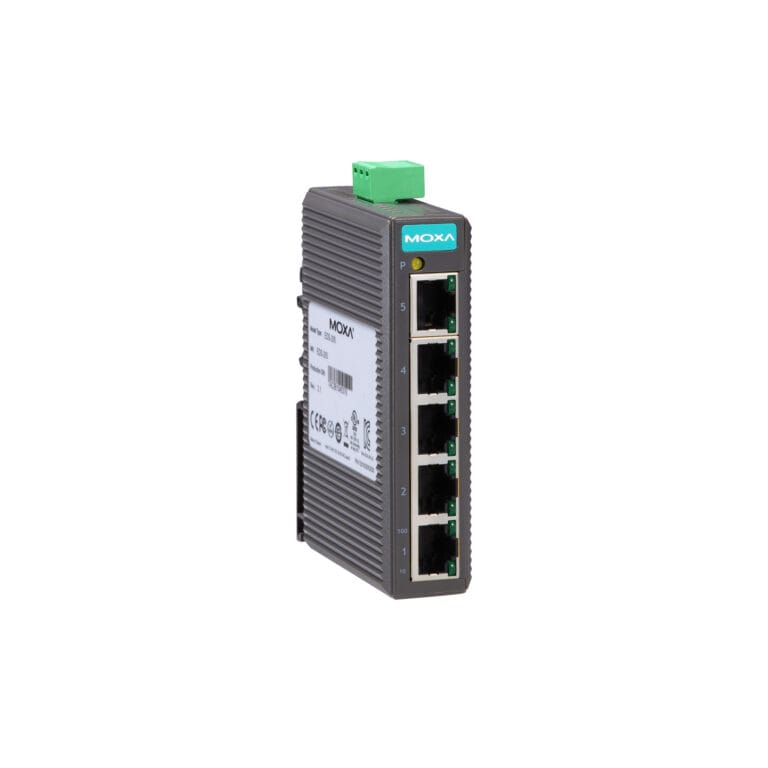
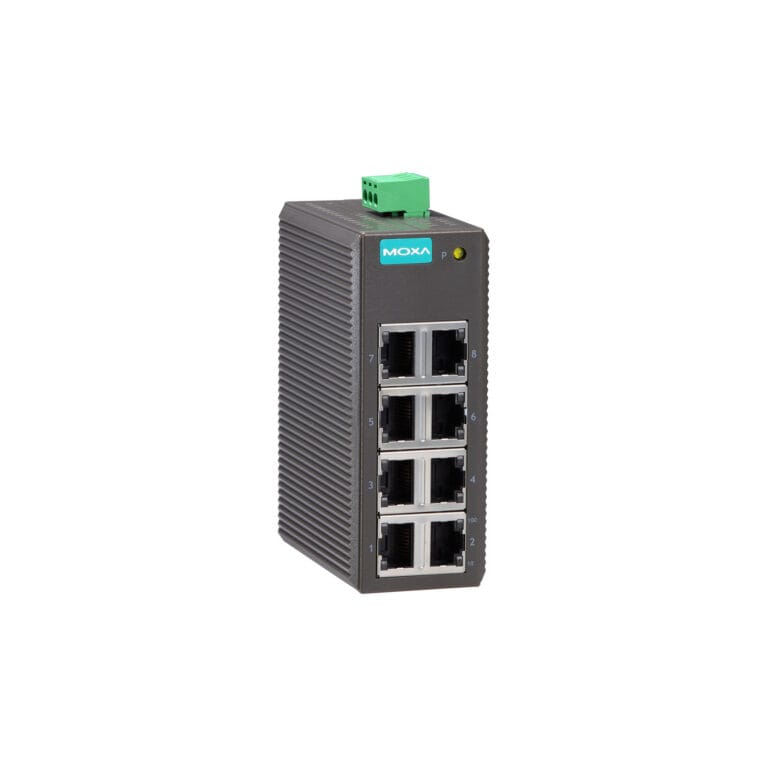
Represented by the 5-port EDS-205 and 8-port EDS-208, this is Moxa’s long-standing standard.
- Physical Build: Housed in a simple, IP30 plastic casing with a classic, wider footprint (the 5-port is 24.9 mm wide).
Power Versatility: Exceptionally flexible, supporting standard 12/24/48 VDC and legacy 24 VAC building power via a 3-contact terminal block. - Capabilities: Features an industry-leading MTBF (~18.9 million hours on the 5-port). The 8-port model offers fibre variants (Multi-mode ST/SC). However, the series lacks toggleable QoS and extreme environmental ratings.
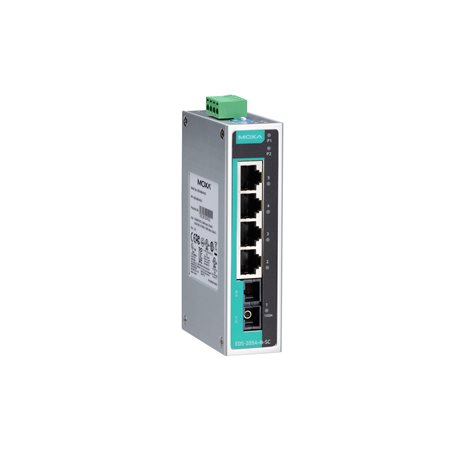
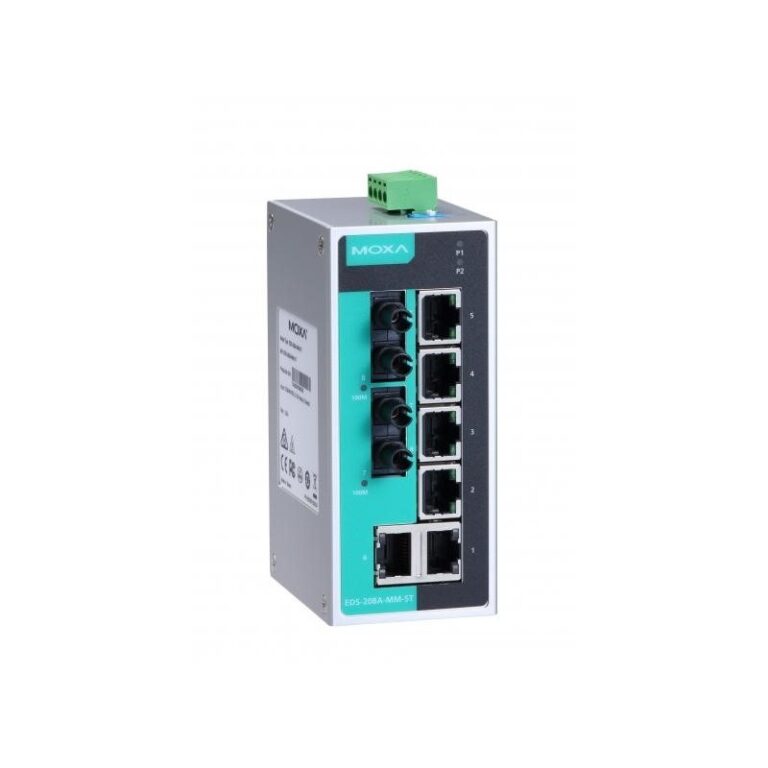
Comprising the EDS-205A and EDS-208A, this is a heavily ruggedised, specialised variation.
- High Reliability: Encased in a robust IP30 aluminium housing with redundant dual VDC power inputs. Extensive fibre-optic configurations are available across both 5-port and 8-port models.
- Advanced Certifications: Carries global certifications for maritime use (DNV, LR, ABS), hazardous locations (ATEX Zone 2, Class I Division 2), and roadside/rail systems (NEMA TS2, EN 50121-4).
- The Feature Quirk: While the 5-port EDS-205A boasts DIP-switch QoS and PROFINET CC-A compliance, the 8-port EDS-208A lacks QoS and PROFINET CC-A entirely.
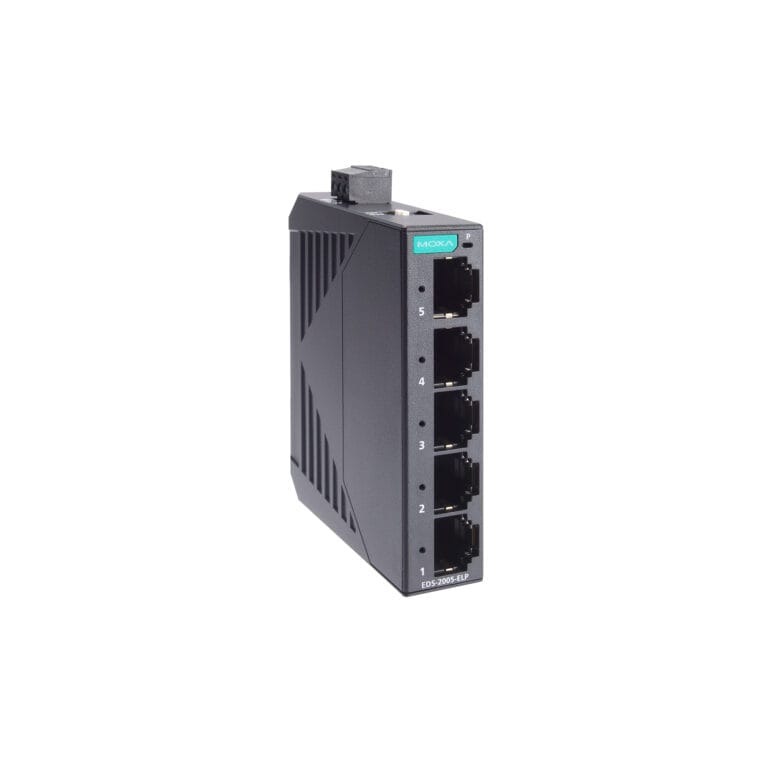
Designed specifically to address the space limitations of crowded, modern control panels.
- Physical Build: Features a highly compact, IP40 plastic housing. The 5-port model is narrowed to only 19 mm wide, saving massive DIN-rail space.
- Consistent Intelligence: Unlike the 200A series, the ELP provides DIP-switch QoS, toggleable BSP, and PROFINET Conformance Class A (CC-A) across all models (both 5 and 8-port).
- Limitations: Strictly copper ports (no fibre options) and standard operating temperatures (-10 to 60°C).
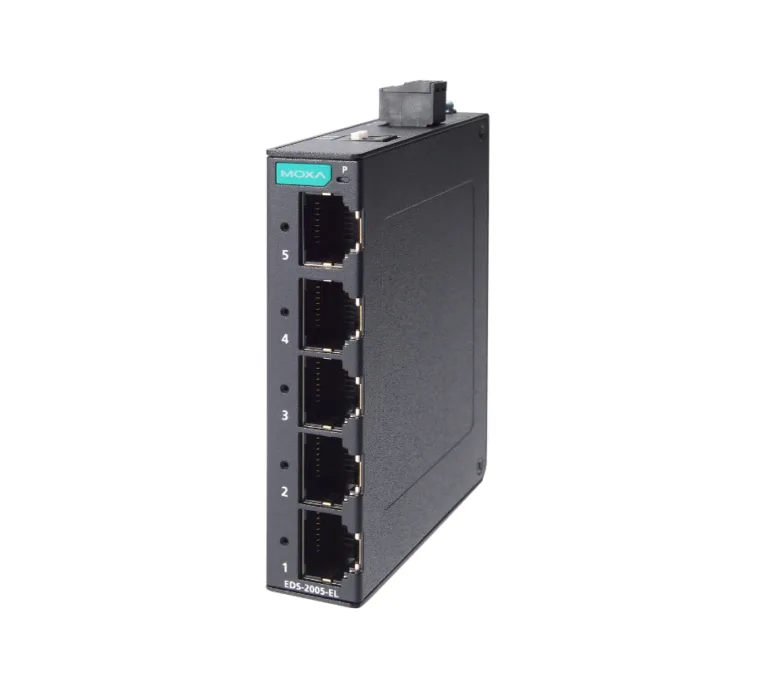
- Physical Build: Encased in an IP40-rated metal housing. The 5-port model is an ultra-thin 18 mm wide.
- Durable and Adaptable: Available in wide-temperature (-T) models rated for -40 to 75°C.
- Fibre Integration: The 8-port metal models offer options for one Fast Ethernet fibre-optic port (Multi-mode SC or ST), protecting long-distance data from severe electromagnetic interference (EMI).
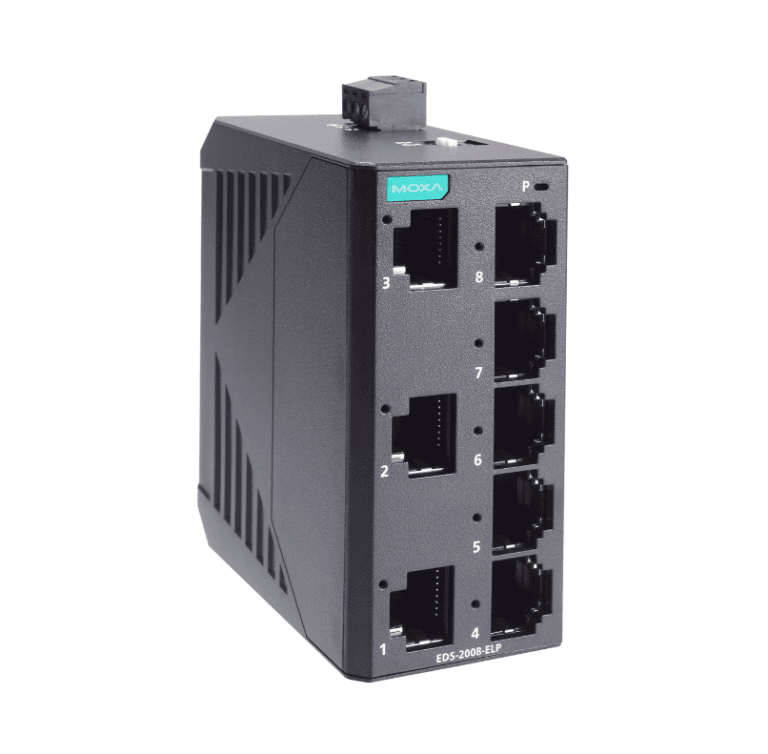
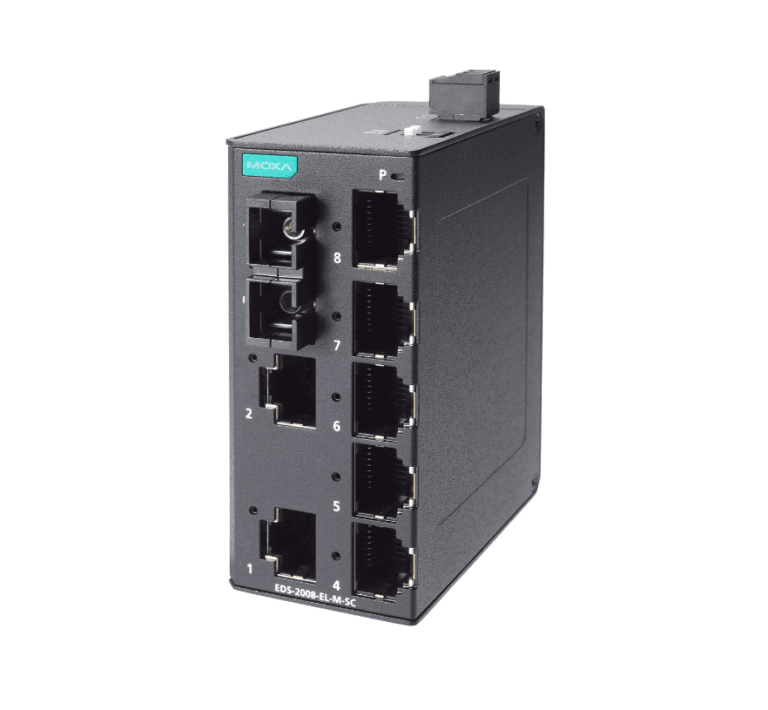
Unified MOXA 100 Mbps Switch Comparison Table
| Technical Feature | EDS-200 Series | EDS-200A Series | EDS-2000-ELP Series | EDS-2000-EL Series |
|---|---|---|---|---|
| Housing Material | Plastic | Aluminium | Plastic | Metal |
| Ingress Protection | IP30 | IP30 | IP40 | IP40 |
| 5-Port Dimensions (W x H) | 24.9 x 100 mm | 30 x 115 mm | 19 x 81 mm | 18 x 81 mm |
| QoS (Traffic Prioritisation) | No | Yes on 205A only (No on 208A) | Yes (via DIP switch) | Yes (via DIP switch) |
| BSP (Storm Protection) | Built-in (Always Active) | Toggleable (via DIP) | Toggleable (via DIP) | Toggleable (via DIP) |
| PROFINET CC-A | Not Specified | Yes on 205A only (No on 208A) | Yes (Hardware v2.0+) | Yes (Hardware v2.0+) |
| Power Inputs | VDC & 24 VAC | Dual Redundant VDC | Single VDC Only | Single VDC Only |
| Fibre Port Options | Yes (8-port models) | Yes (5 & 8-port models) | No | Yes (8-port models) |
| Specialised Certifications | No | Yes (-40 to 75°C) | No | Yes (-40 to 75°C) |
| Extreme Temp. Models (-T) | ~18.9 Million Hours | Up to 3.9 Million Hours | ~5.2 Million Hours | ~5.2 Million Hours |
| MTBF (5-Port) | ~18.9 Million Hours | Up to 3.9 Million Hours | ~5.2 Million Hours | ~5.2 Million Hours |
| MTBF (8-Port Copper) | ~10.5 Million Hours | Up to 3.2 Million Hours | ~3.7 Million Hours | Up to 3.7 Million Hours |
Industry Blueprints: Choosing the Right Switch for Your Application
Selecting the ideal switch is not about finding the “best” overall unit, but the one that aligns perfectly with your physical space, electrical architecture, and data requirements.
Based on Moxa’s deployment data and APulsar’s engineering experience in the field, we recommend the following strategic blueprints.
Blueprint 1: The "New Build" Standard (Default to EDS-2000)
For all greenfield developments and standard factory automation, the EDS-2000-EL or ELP Series is superior in almost every metric compared to the classic EDS-200.
- Consistent Intelligence: If you build a panel with a 5-port switch and later scale to an 8-port, the EDS-2000 series guarantees you retain QoS and PROFINET CC-A compliance. (Scaling up with the older EDS-200A means losing these features).
- Space Optimisation: At under 2 cm wide for the 5-port model, it frees up critical DIN-rail real estate for more complex IO modules.
Blueprint 2: The "Retrofit" Strategy (Swapping Older EDS-200 Models)
If you are managing an older facility with legacy control panels, your selection strategy requires attention to electrical details.
- The Power Catch (24 VAC): The older EDS-200 series supports 24 VAC power (common in legacy building automation). The newer EDS-2000 series is strictly DC-powered (12/24/48 VDC). If your panel lacks a DC power supply, you must stick with the classic EDS-200.
- Direct Replacement: If a legacy EDS-200 unit has completed its service life, purchasing the exact same model remains a low-risk choice that fits your existing wiring drawings perfectly.
Blueprint 3: The Heavy-Duty Exception (When the EDS-200A is Unbeatable)
While the EDS-2000 series wins on space and standardisation, the EDS-200A Series remains the undisputed choice for extreme industrial environments and niche architectures.
- 5-Port Fibre Networks: If you need a compact 5-port switch with a fibre-optic connection, the EDS-205A supports it. The EDS-2000 series only offers fibre on its larger 8-port chassis.
- Zero-Downtime Power: The EDS-200A allows you to connect two independent power sources simultaneously, guaranteeing the network survives a primary power failure.
- Mandatory Certifications: The EDS-200A is legally and physically equipped for hazardous environments, carrying mandatory approvals for explosive atmospheres (ATEX Zone 2) and marine vessels (DNV).
Vertical Market Recommendations
| Application Category | Target Use Case | Key Requirements & Features | Recommended Model |
|---|---|---|---|
| Space-Constrained & Mobile | AGVs & Robotics | – Ultra-thin profile (< 2 cm) -Vibration-resistant model -Microsecond-level latency |
EDS-2005-EL EDS-2008-EL |
| Standard Manufacturing Line | Factory Automation | -Guaranteed PROFINET CC-A -Toggleable QoS on all ports -Maximum cost & space efficiency |
EDS-2005-ELP EDS-2008-ELP |
| Extreme Environmental | Oil, Gas & Marine | -Redundant dual DC power – HazLoc/Marine certs (ATEX/DNV) -Heavy-duty IP30 aluminium |
EDS-205A / EDS-208A |
Warehouse Logistics & AGVs (Automated Guided Vehicles)
- The Challenge: Warehouse robots operate in tight internal compartments with absolutely zero room to spare. Because they are constantly moving, stopping, and turning, they subject internal electronics to intense physical vibrations.
- The Recommendation: EDS-2000-EL Series (Metal). At just 18 mm wide for the 5-port model, it slips easily into space-constrained AGV chassis. Its rugged metal housing provides the necessary vibration resistance, and its microsecond-level latency ensures the AGV’s wireless client, motor controllers, and obstacle sensors stay in constant, real-time sync with the warehouse control room.
Factory Automation & Smart Assembly Lines
- The Challenge: High-speed packaging, assembly, and smart manufacturing lines generate immense amounts of data. They rely heavily on standard industrial protocols like PROFINET, where a millisecond delay in machine-to-machine coordination can halt a smart conveyor belt.
- The Recommendation: EDS-2000-ELP Series (Plastic). In standard indoor factory cabinets, metal housing or ATEX ratings are rarely needed, but space efficiency and traffic management are crucial. The ELP series provides the exact same QoS “fast lane” and PROFINET Conformance Class A (CC-A) readiness as the metal models, but in a highly cost-effective plastic chassis perfect for scaling up large assembly lines.
Remote Infrastructure, Marine, & Oil and Gas
- The Challenge: Oil well monitoring panels or offshore drilling rigs are subject to extreme heat, salty air, and hazardous, combustible atmospheres. Because these sites are remote, a switch failure can require a helicopter crew to fix, making downtime incredibly expensive.
- The Recommendation: EDS-200A Series (Aluminium). For these critical industries, redundant power is a non-negotiable insurance policy against panel outages. The heavy-duty aluminium build, dual power inputs, and robust hazardous area certifications (Class I Div 2 / ATEX) ensure safe, continuous uptime in explosive or seaside atmospheres where standard compact switches are legally and physically unfit.
Why Partner with APulsar Technologies for Your Next Project?
Designing a resilient industrial network requires more than just picking a switch from a catalogue; it demands a deep understanding of legacy integration, environmental hazards, and evolving digital architectures.
At APulsar Technologies, we don’t just process part numbers. We act as your dedicated engineering partner and official MOXA distributor in Malaysia. Whether you need to source specific heavy-duty EDS-200A units with maritime certifications to replace a legacy panel, or you are standardising a new fleet of AGVs with the ultra-compact EDS-2005-EL, our team ensures you get the exact technical specification your architecture demands.
Avoid the pitfalls of legacy power mismatches and network bottlenecks. Contact the APulsar digital and technical team today to discuss your control cabinet requirements, and let us streamline your procurement process from blueprint to deployment.
Frequently Asked Questions (FAQ)
To simplify your cabinet planning, we have compiled the ultimate technical FAQ for Moxa’s unmanaged switches.
What is the core difference between EDS-200, EDS-200A, and EDS-2000?
The EDS-200 is the classic plastic switch supporting both VDC and 24 VAC power. The EDS-200A is a heavy-duty aluminium model with dual redundant VDC inputs, maritime/hazardous certifications, and niche fibre options. The EDS-2000 is the modern, ultra-compact line that standardises QoS, BSP, and PROFINET compliance across all its port configurations.
Do all these switches have QoS and Broadcast Storm Protection?
No. The classic EDS-200 only has built-in, unchangeable BSP and lacks QoS entirely. The EDS-200A has toggleable BSP, but only the 5-port model (EDS-205A) supports QoS. The EDS-2000 standardises both toggleable BSP and QoS across its entire lineup.
What is the difference between EDS-2000-EL and ELP?
The EL (Metal) is housed in IP40 metal, offers wide-temperature (-40 to 75°C) options, is slightly thinner at 18 mm, and provides fibre port options on its 8-port models. The ELP (Plastic) operates only at standard temperatures (-10 to 60°C), is 19 mm wide, and lacks fibre options entirely.
What is PROFINET Conformance Class A (CC-A)?
CC-A certification ensures the switch is fully compatible with standard PROFINET automation networks. When you toggle the QoS DIP switch “ON”, the switch activates multicast filtering, which drops non-essential background traffic to keep the network clear for real-time PLC control instructions. (Note: EDS-205A and all EDS-2000 models support this; EDS-208A does not).
What is the difference between IP30 and IP40 ratings?
Neither rating offers protection against water (indicated by the “0”). However, IP40 protects against solid objects larger than 1.0 mm (like thin wires or loose screws), preventing them from falling inside the chassis and causing short circuits. IP30 only protects against objects larger than 2.5 mm.
What is the difference between VDC and VAC input?
VDC is Direct Current (standard for industrial DC supplies), while VAC is Alternating Current (standard for building mains). The legacy EDS-200 series supports both, whereas the EDS-200A and modern EDS-2000 series are DC-powered only.
What is MTBF and how is it used?
MTBF (Mean Time Between Failures) is a statistical prediction of a device’s operational reliability, helping engineers calculate the Total Cost of Ownership (TCO). For example:
- EDS-205 (Classic): ~18,921,624 hours (approx. 2,160 years).
- EDS-2005-EL (Next-Gen): ~5,249,061 hours (approx. 599 years).
- EDS-205A (Heavy-Duty): ~3,969,664 hours (approx. 453 years).
Get in touch!
Reach out to APulsar today to secure these Moxa products at special prices. Our team in Petaling Jaya is ready to assist you with fast delivery across Malaysia.
And if you would like to see more product news like this one, don’t forget to subscribe to our newsletter below!