
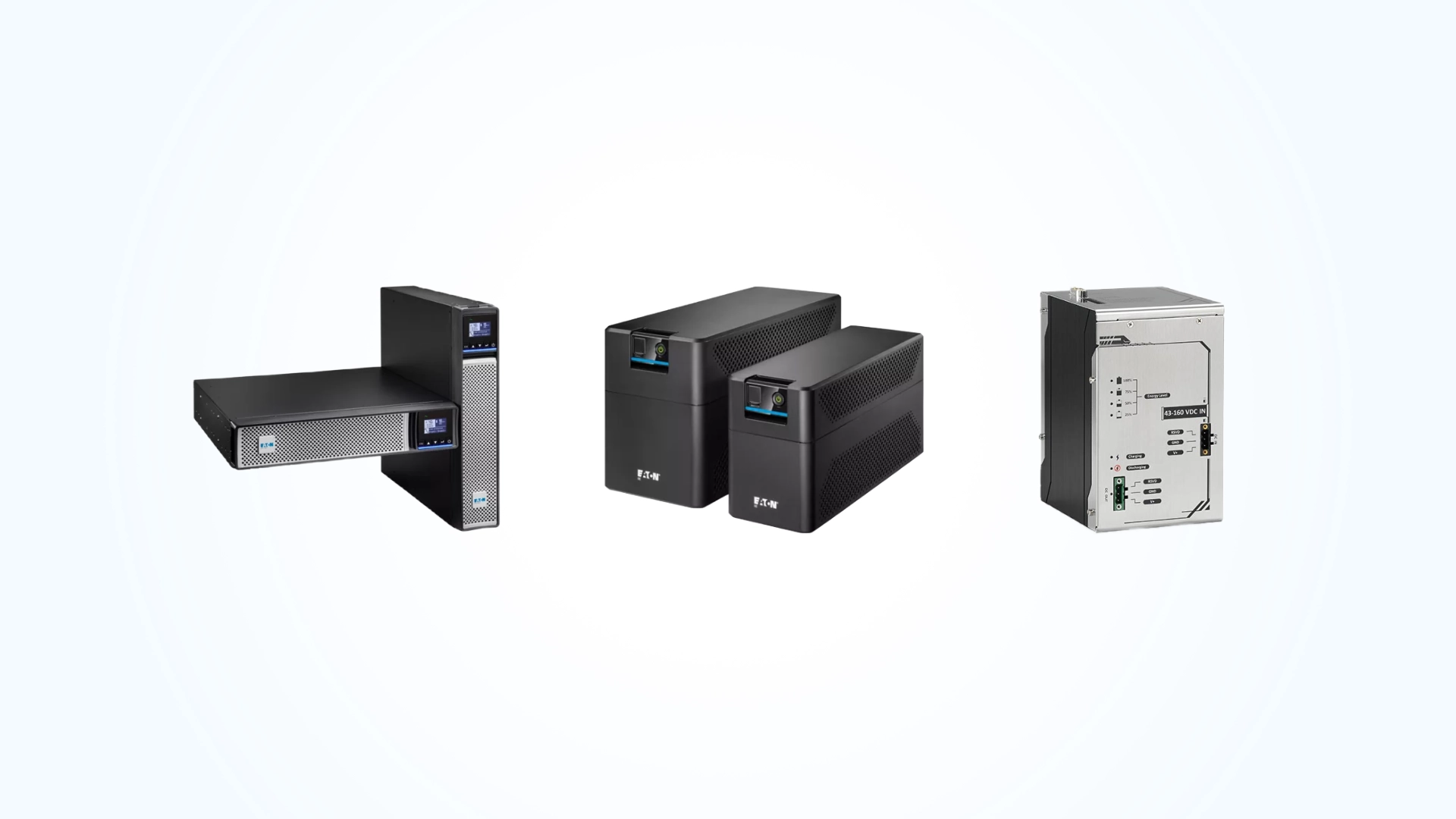
What is a UPS? An Uninterruptible Power Supply (UPS) is a hardware device that provides instant backup electrical energy to connected equipment during a power outage or grid instability. Modern enterprise and industrial systems (such as those from Eaton and Neousys) primarily utilise three storage technologies: VRLA (Lead-Acid) batteries, Lithium-Ion batteries, or Supercapacitors.
Modern UPS systems stabilise voltage spikes and sags while housing a power storage system. The exact logic varies depending on the UPS design:
- Standby* and Line-Interactive*: Switch to backup power only after detecting a significant drop or failure in the external supply.
- Online Double-Conversion*: Keep the battery continuously connected to the internal power flow, offering a seamless, zero-transfer-time transition to backup power.
*You can read more about UPS topology on Eaton’s official website.
Depending on your objective, a UPS is used either to keep operations running continuously until primary power is restored, or to buy enough time to safely shut down equipment.
UPS Technologies: VRLA vs Lithium vs Supercapacitors
The most common UPS systems rely on traditional VRLA or modern Lithium-Ion chemistries, while specialised edge computing applications utilise electrostatic Supercapacitors.
| Storage Technology | Expected Lifespan | Charge Cycles | Optimal Environment | Primary Use Case |
|---|---|---|---|---|
| VRLA (Lead-Acid) | 3 to 5 years | 300 – 500 | 0°C to 40°C (Climate Controlled) | Cost-effective, standard office IT and networking |
| Lithium-Ion | Up to 10 years | 3,000+ | 0°C to 40°C (Climate Controlled) | Extended runtime, dense server racks, small footprint |
| Supercapacitor | >10 years | 500,000+ | -40°C to +70°C (Extreme/Harsh) | Micro-blackouts, automated industrial PC shutdown |
VRLA (Lead-Acid) Batteries: Eaton
VRLA batteries are significantly cheaper upfront. However, their usage is limited to around 300 to 500 full charge/discharge cycles. They generally degrade within 3 to 5 years, meaning they must be replaced a few times over a standard 10-year period, which may increase the total cost long-term. The plus: they don’t require the highly sophisticated internal battery management systems (BMS) needed for Lithium-Ion.
(Note: To maximise ROI on VRLA, Eaton’s proprietary ABM (Advanced Battery Management) technology optimises charge cycles to significantly extend traditional battery life.)
-

Eaton 9SX Gen2 UPS
-
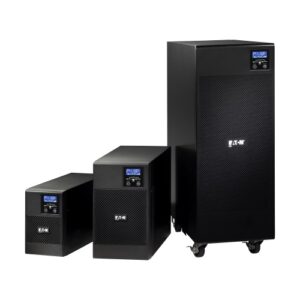
Eaton 9E UPS
-

Eaton 5PX Gen 2 UPS
-
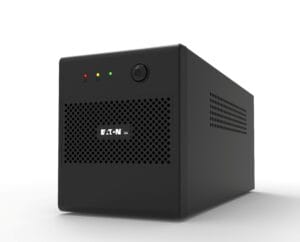
Eaton 5A UPS
Most requested VRLA-based Eaton UPS
Lithium-Ion Batteries: Eaton
Lithium-Ion batteries require a higher initial capital expenditure, but they can serve up to 10 years without replacement thanks to robust 3,000+ charge cycles. Because they safely discharge deeper without damaging the cells, their backup runtime is significantly longer for the same physical footprint. They are also smaller and lighter. To mitigate thermal runaway, reputable lithium units feature strict built-in BMS and advanced safety measures.
-
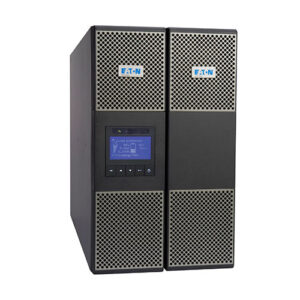
Eaton 9PX UPS
-

Eaton 5P Gen 2 UPS
Eaton UPS 9PX and 5P Series are available with both VRLA and Lithium-Ion batteries
Supercapacitors: Neousys
If your goal is strictly to protect a single, rugged industrial computer from power anomalies, Supercapacitor UPS technology is the definitive choice. These compact devices store energy electrostatically. Because there is no chemical breakdown inside, energy is released almost instantly.
Discharge time is measured in seconds to a couple of minutes — just enough time for the computer to perform a programmed, safe shutdown.
The Benefits: Because they don’t rely on sensitive chemical reactions, supercapacitors excel in extreme temperatures. Models like the Neousys PB-9250J-110V series operate reliably from -40°C up to +70°C, offer a massive 9,250 watt-second energy capacity, and easily pass stringent EN50155 vibration certifications for railway or in-vehicle applications.
-

PB-4600J-SA Series
-

PB-2580J-SA Series
-
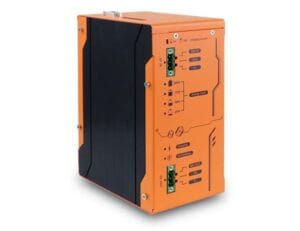
PB-9250J-SA Series
-
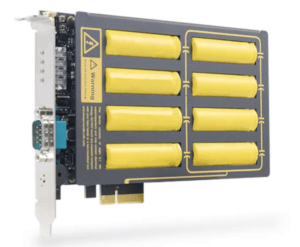
PB-2500J Series
Enterprise vs. Industrial UPS
Broadly speaking, B2B UPS systems divide into Enterprise and Industrial categories based on operational scale and environmental resilience.
Enterprise UPS
Designed to support IT infrastructure in controlled environments. They are ideal for office server rooms, retail networking, or 3D printing farms where temperature and humidity are relatively stable.
- Capacity: Single-phase enterprise models typically handle loads from 700W up to 3kW.
- Runtime: A standalone unit might provide 5 to 15 minutes of backup at maximum load. By adding External Battery Modules (EBMs), systems can provide hours of continuous runtime.
- Recommendations: The Eaton 5PX Gen 2, Eaton 9A, and Eaton Ellipse series are industry standards for reliable enterprise performance.
Industrial & Marine UPS
Built heavier, deliver significantly more power (reaching up to 11 kW and beyond), and secure rigorous industry-specific certifications for harsh environments.
- Marine & Offshore: Marine-grade UPS units require specialized anti-vibration chassis and coated boards to survive constant motion and salt air.
- Recommendations: The Eaton 9SX Gen2 and Eaton 9PX series dominate heavy industry. Specifically, the Eaton 9PX Marine and 9SX Marine hold DNV-GL and ABS type approvals for offshore environments. For protecting an edge computer in these exact conditions, Neousys Supercapacitors featuring patented CAP energy management are optimal*.
*You can read more about Neousys Supercapacitors and their CAP Energy Management Technology on their official website.
FAQ: Choosing the right UPS
Frequently Asked Questions
Both Lithium-ion and Supercapacitor UPS boast a 10-year lifespan. Which should I choose?
It entirely depends on your operating environment and runtime requirements:
- Choose Lithium-ion if you need hours of backup power to keep a server rack or networking hardware running, and the equipment is located in a standard, climate-controlled environment (0°C to 40°C).
- Choose Supercapacitors if you only need a few seconds or minutes to safely shut down an industrial PC, and the equipment is located in extreme environments (-40°C to +70°C) where traditional chemical batteries would rapidly degrade.
Which UPS topology is right for me?
- Line-Interactive (e.g., Eaton 5PX Gen 2): Excellent for standard networking gear where the grid is mostly stable.
- Online Double-Conversion (e.g., Eaton 9A or 9PX): Necessary for highly sensitive medical equipment, running on a backup diesel generator, or severely unstable grids to ensure complete isolation.
- Supercapacitors (e.g., Neousys PB-9250J-110V): Best when you require harsh-environment/vibration certifications (like EN50155) and only need enough time for automated data saving.
Should I choose a VRLA or Lithium-Ion UPS from Eaton?
The standard recommendation is Lithium-Ion if your project budget allows it. However, when initial capital expenditure is constrained, VRLA remains a cost-effective choice—especially thanks to Eaton’s ABM technology, which automatically monitors and optimises charge cycles to extend traditional battery life.
What is the difference between a Neousys standalone supercap UPS and an expansion card?
Standalone units function like traditional external UPS modules — they are external enclosures delivering backup power to connected devices via standard cabling. Expansion cards install directly inside compatible modular industrial PCs (via PCIe or dedicated internal slots), providing an all-in-one backup solution without taking up additional external mounting space.
Get in touch!
Still unsure how to calculate your watt load, battery runtime, or which topology fits your facility? At APulsar, our engineering team can help you map out the exact Eaton or Neousys backup solution to keep your critical operations running.
And if you would like to see more useful guides like this one, don’t forget to subscribe to our newsletter below!

This is the heading
Lorem ipsum dolor sit amet, consectetur adipiscing elit. Ut elit tellus, luctus nec ullamcorper mattis, pulvinar dapibus leo.