
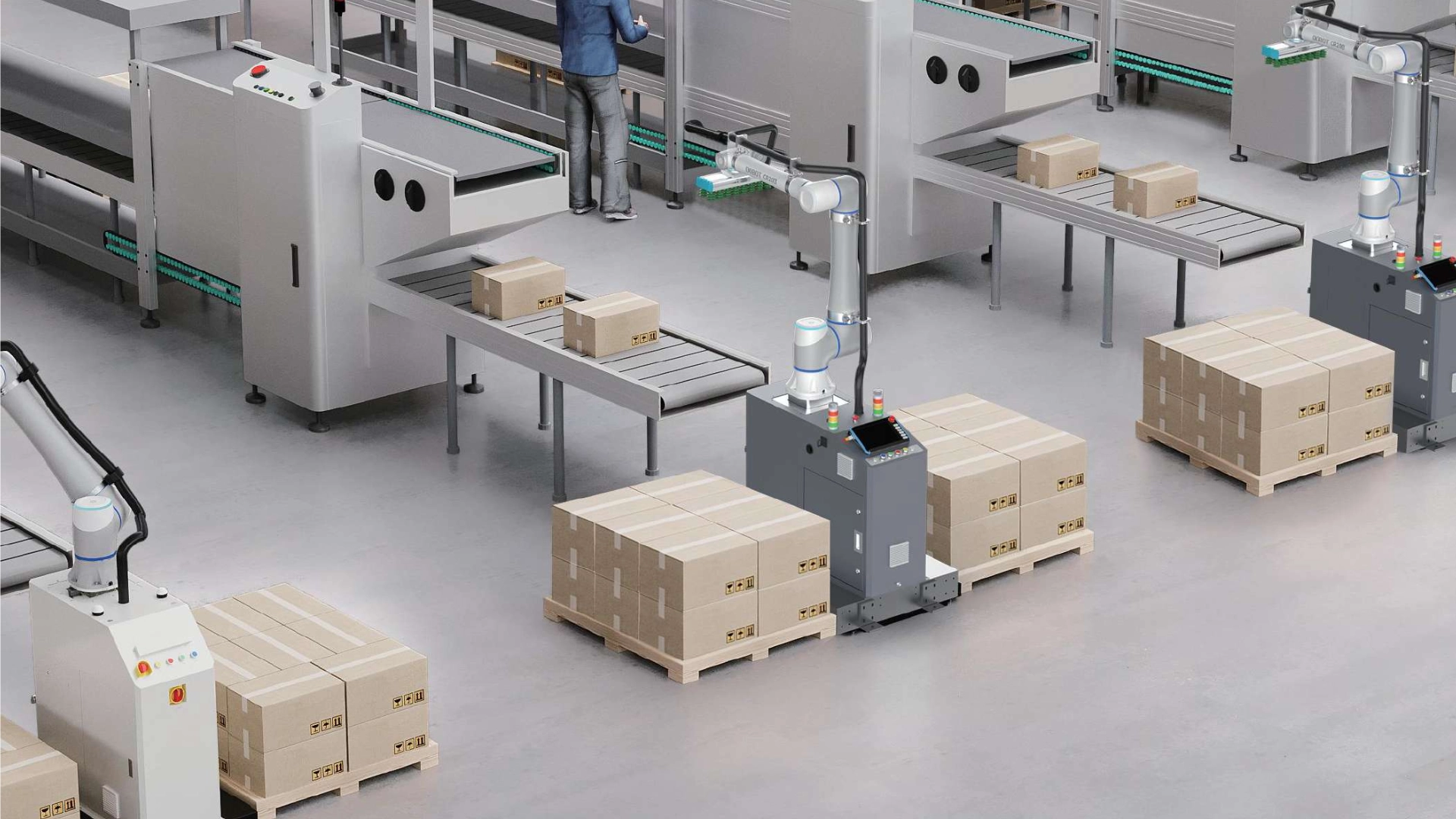
Palletising is no longer just about moving boxes; it is about precision, safety, and the strategic use of space. In modern manufacturing, warehousing, and logistics end-of-line automation is the critical bottleneck where production speeds often outpace human physical limits.
If your facility struggles with high turnover in physically demanding roles, inconsistent stacking quality, or severely limited floor space, traditional manual workflows are steadily undermining your bottom line. This comprehensive guide explores how Dobot collaborative robots (cobots) are transforming palletising operations across the Malaysian market, and how a dedicated integration partner like APulsar turns complex robotics into an effortless upgrade.
Mastering the End-of-Line: Palletising vs. Depalletising
Efficiency at the start and the absolute end of a production cycle dictates the rhythm of your entire facility. While they sound identical to the untrained ear, palletising and depalletising serve fundamentally opposite functions in the supply chain.
- Palletising (Outbound): The systematic process of stacking finished, packaged products onto a pallet for storage or shipment. This is dominant in production economies that export finished goods. The goal is to calculate complex, interlocking stacking patterns to ensure the load does not collapse during transport.
- Depalletising (Inbound): The exact reverse. This happens at the beginning of a cycle when raw materials arrive. For example, a Malaysian electronics plant might receive a pallet of raw capacitors; depalletising is the act of taking those components off the pallet and placing them onto a conveyor belt to feed the assembly line. This is common in purchasing economies.
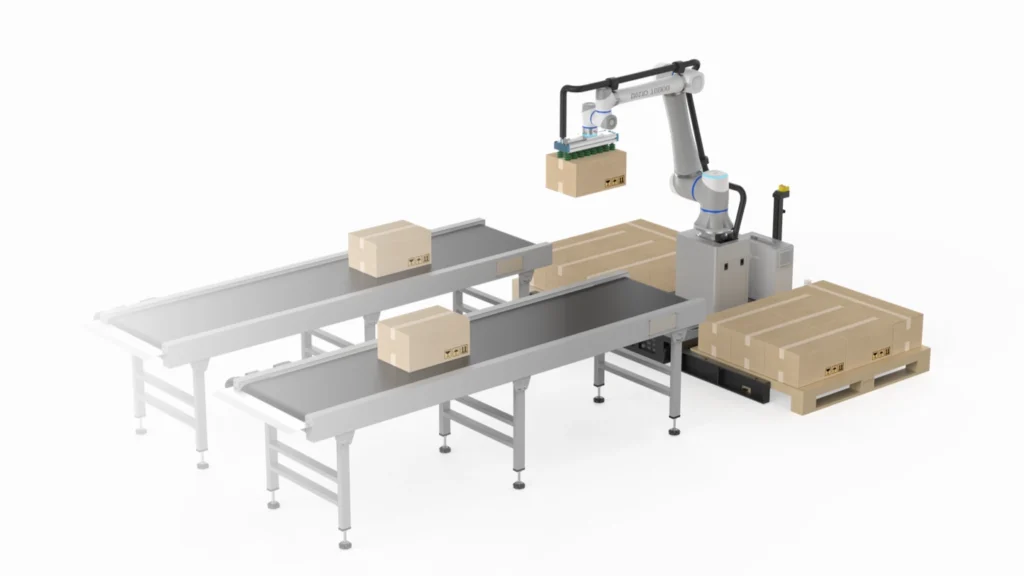
These solutions are essential across multiple vertical markets, including Food and Beverage (heavy juice cartons, delicate chocolate packaging), 3C Electronics and Home Appliances, Chemicals and Healthcare (hazardous materials, plastic bottles), and large-scale Logistics and Warehousing.
Beyond Pick-and-Place: The Intelligence of Stacking
It is easy to confuse palletising with standard “pick-and-place” tasks. Standard pick-and-place is a simple point-to-point transfer—such as placing ten individual packs of noodles into a single carton. Palletising, however, is a sophisticated architectural operation that relies on building stable, multi-layered matrix structures.
Here is how the robotic system manages this complexity:
The "Far-to-Front" Rule and Interlayers
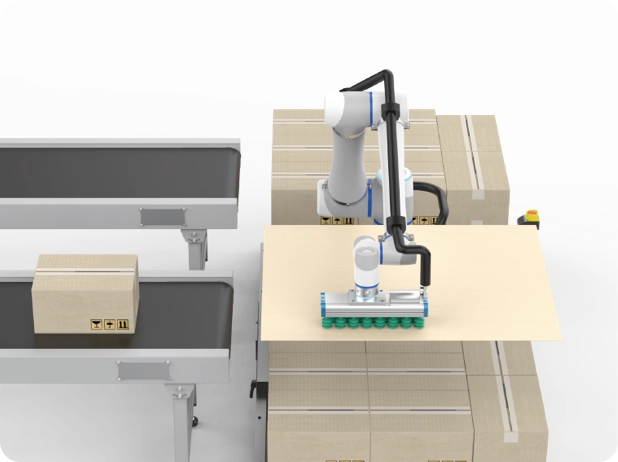
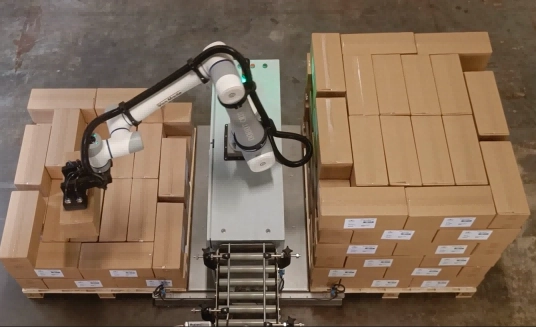
An essential, unbending rule in automated palletising is that the robot must always load the farther sides of the pallet first before moving to the front. This is dictated by physical reach limitations. If the robot placed boxes at the front first, those boxes would act as a physical wall. As the stack grows taller, the arm would not be able to “reach over” these obstacles to access the back corners. Loading strictly from back-to-front guarantees a clear, low, and direct movement path, drastically improving cycle speeds.
Additionally, to maintain the structural integrity of these towering loads, the programming seamlessly integrates the placement of interlayers. If a tall stack requires extra friction and stability to prevent shifting or crushing during transport, the cobot can be programmed to periodically pause box loading, use its vacuum grippers to pick up a cardboard partition sheet (a slip sheet or interlayer), and perfectly position it between the tiers. This simple action effectively locks the entire matrix together.
Wizards vs. Manual Coding
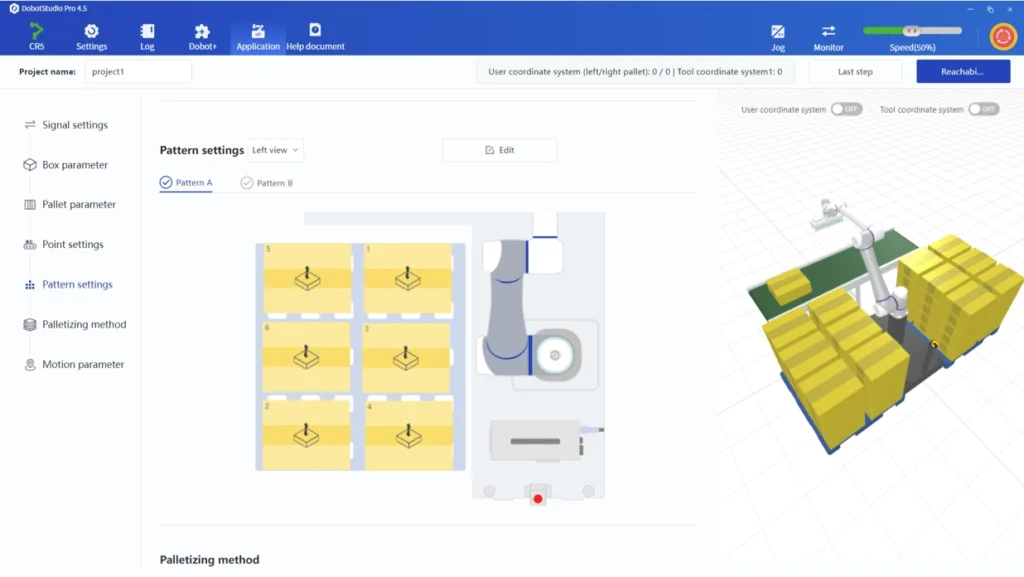
Manually programming every individual 3D coordinate for a multi-layer pallet is an exhausting task that, as industry experts joke, would make a robot programmer “cry.” Dobot eliminates this complexity with the Palletizing Process Package.
Instead of writing code, the operator uses a 4-step software wizard:
- Workstation Configuration: Define the physical layout.
- Box & Pallet Setup: Input the exact dimensions and weight.
- Stack Pattern Design: The algorithm automatically generates the optimal interlocking arrangement.
- Generate Motion Trajectory: The system autonomously calculates the most efficient movement paths.
This “magical wand” approach eliminates up to 80% of traditional debugging time. A station can be fully operational in just 30 minutes, and the system stores up to 20 different templates, allowing you to switch between product lines with just a few clicks.
Cobots vs. Industrial Robots: Reclaiming Your Floor Space
When upgrading end-of-line operations, businesses must choose between traditional industrial robots and collaborative robots (cobots). The decision usually comes down to how much of your warehouse you are willing to sacrifice to a machine.
The Death of the Safety Fence
The absolute greatest advantage of a cobot is that it does not require a safety fence. Industrial robots are high-speed, high-power machines inherently dangerous to humans. They must be isolated behind heavy metal cages, creating a massive “no-go” zone.
Dobot cobots, however, are equipped with proactive safety features that allow them to work directly alongside humans:
- SafeSkin: A contactless detection technology that forces the robot to stop before it physically touches a human.
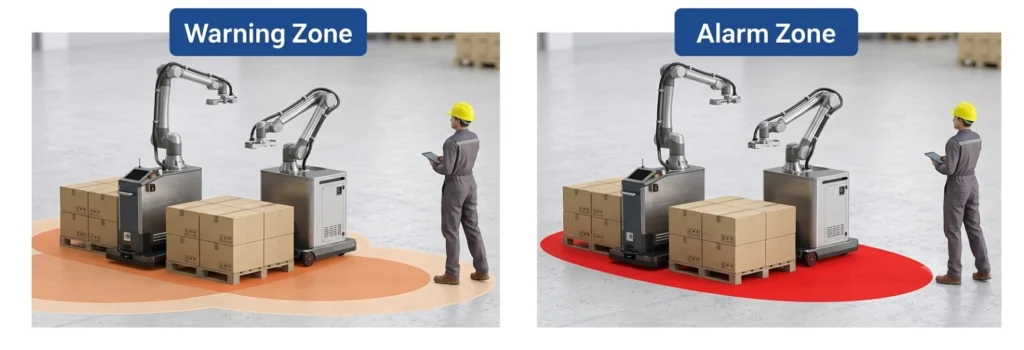
- Dual/Triple LiDAR Systems: These provide 270° coverage exceeding 3 metres. If a worker enters the “Warning Zone,” the robot drops to 10% speed. If they step into the “Alarm Zone,” it stops instantly.
- 5-Level Collision Detection: Utilising a human-safe 48V architecture to ensure complete safety if physical contact ever occurs.
Simplified Forklift Logistics
Because they lack bulky cages, cobots offer massive space savings. A Dobot workstation might only require 20m² of space, whereas an industrial setup requires double or triple that footprint. Furthermore, in an industrial setup, a forklift retrieving a full pallet must navigate expensive safety light curtains or interlocked gates, often halting production. With a fence-free cobot, forklifts can approach the station directly from any angle, streamlining the flow of goods.
Note: If your production requires moving items heavier than 30 kg, or mandates extreme high-speed throughput that exceeds collaborative safety regulations, a caged industrial robot remains your only option.
The Hardware Toolkit: Choosing the Right Dobot
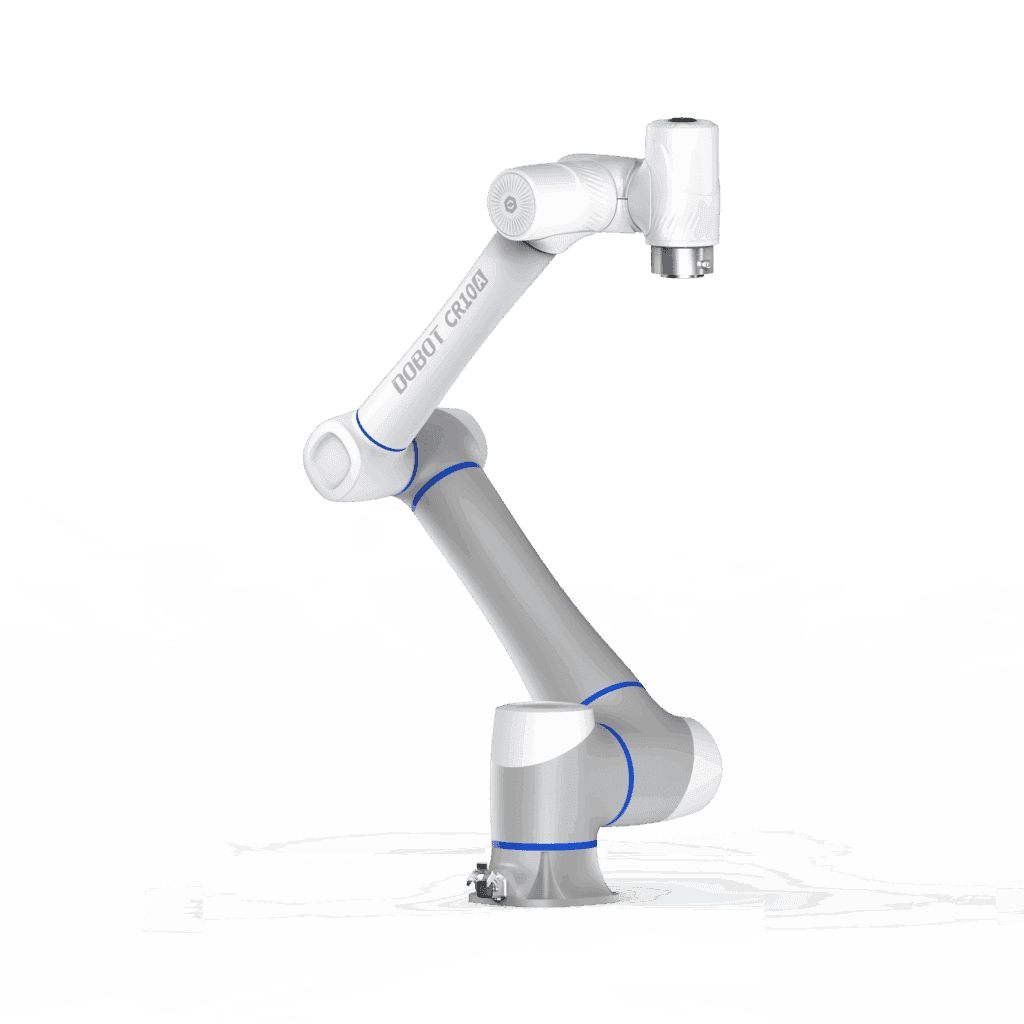
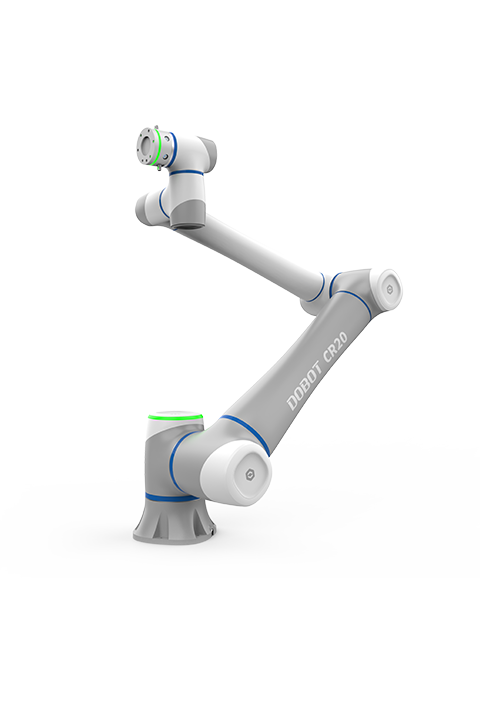
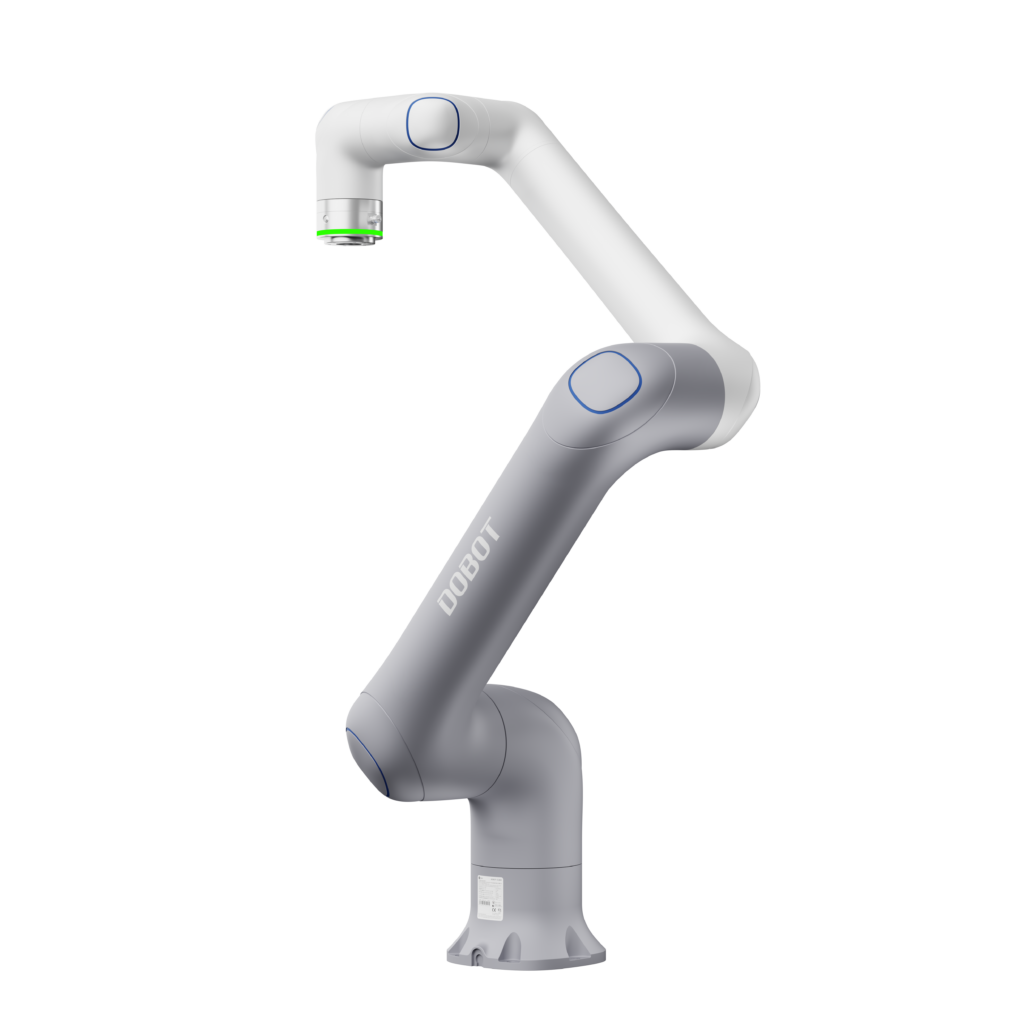
Dobot has engineered specific models optimised for varying payload and height requirements.
Overcoming Height Limitations
To maximise warehouse density, Dobot offers two physical structures.
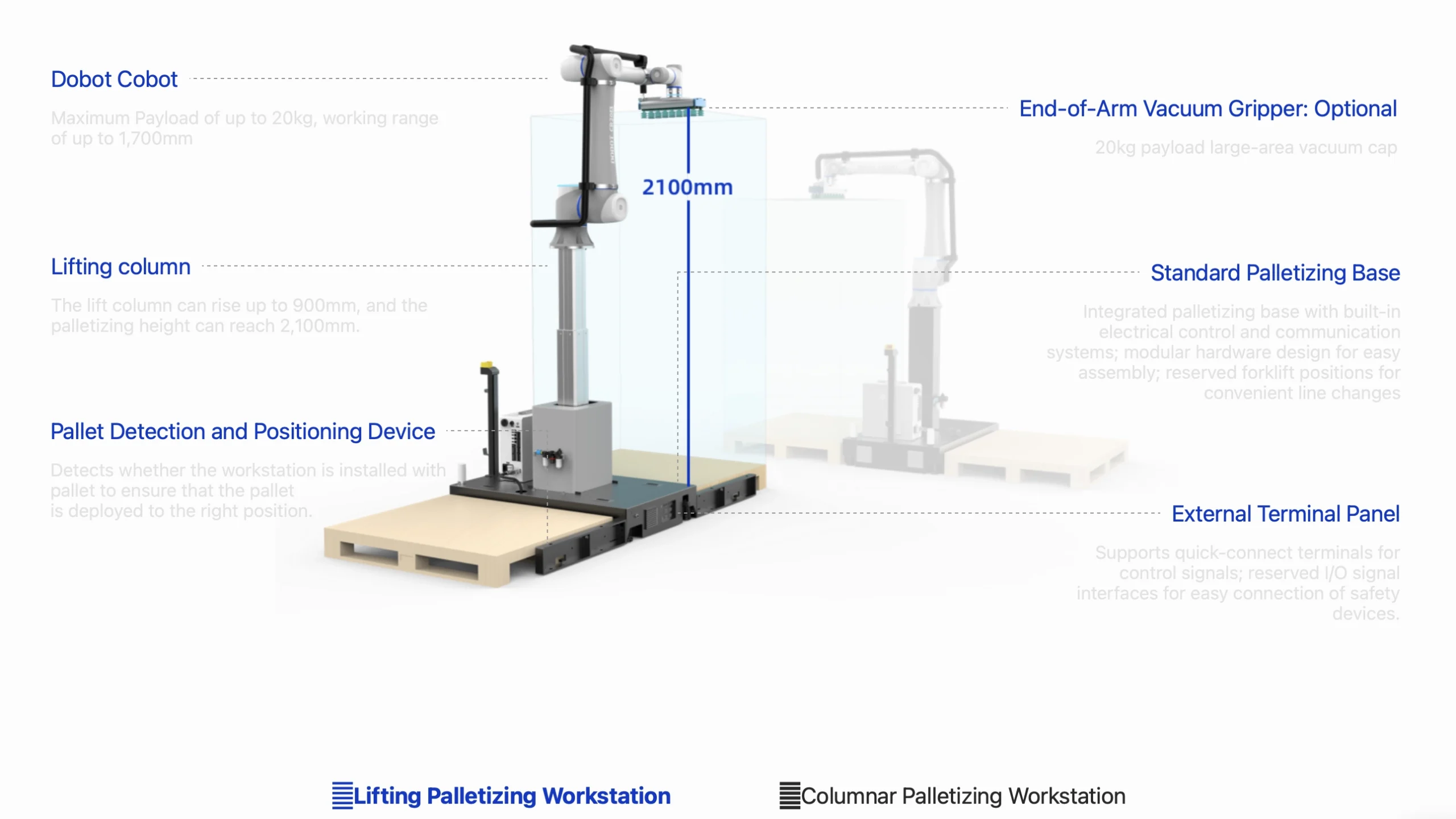
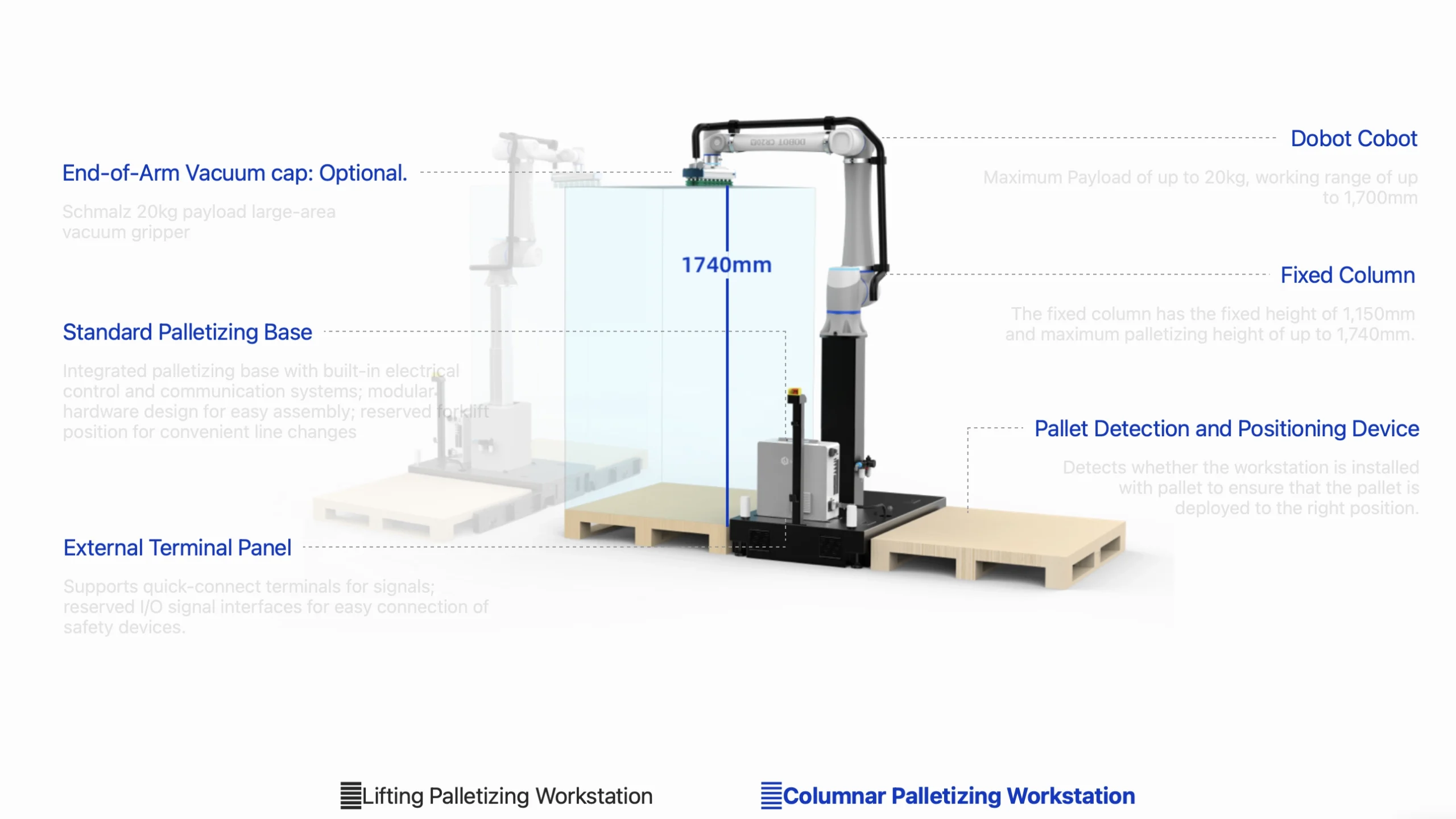
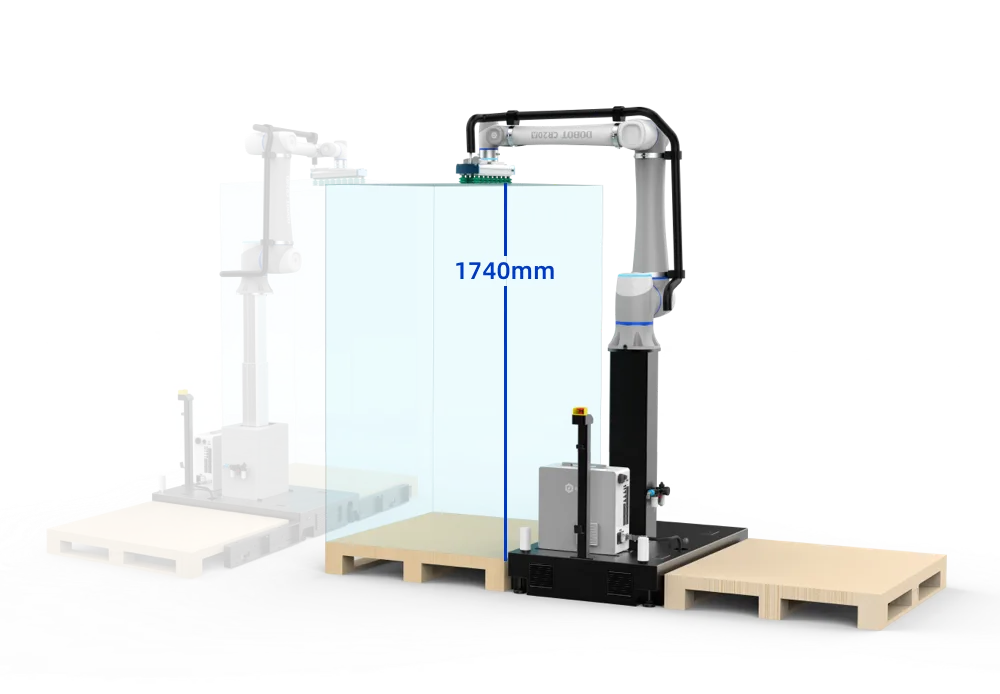
- Columnar Workstation: Uses a fixed mounting column (1,150 mm high). It allows the CR20A to reach a standard stacking height of 1,740 mm.
- Lifting Workstation: Features an active, adjustable column that rises by 900 mm during operation. This allows the system to build towering pallets, reaching 2,100 mm for the CR20A, and up to a massive 2,590 mm for the CR30H.
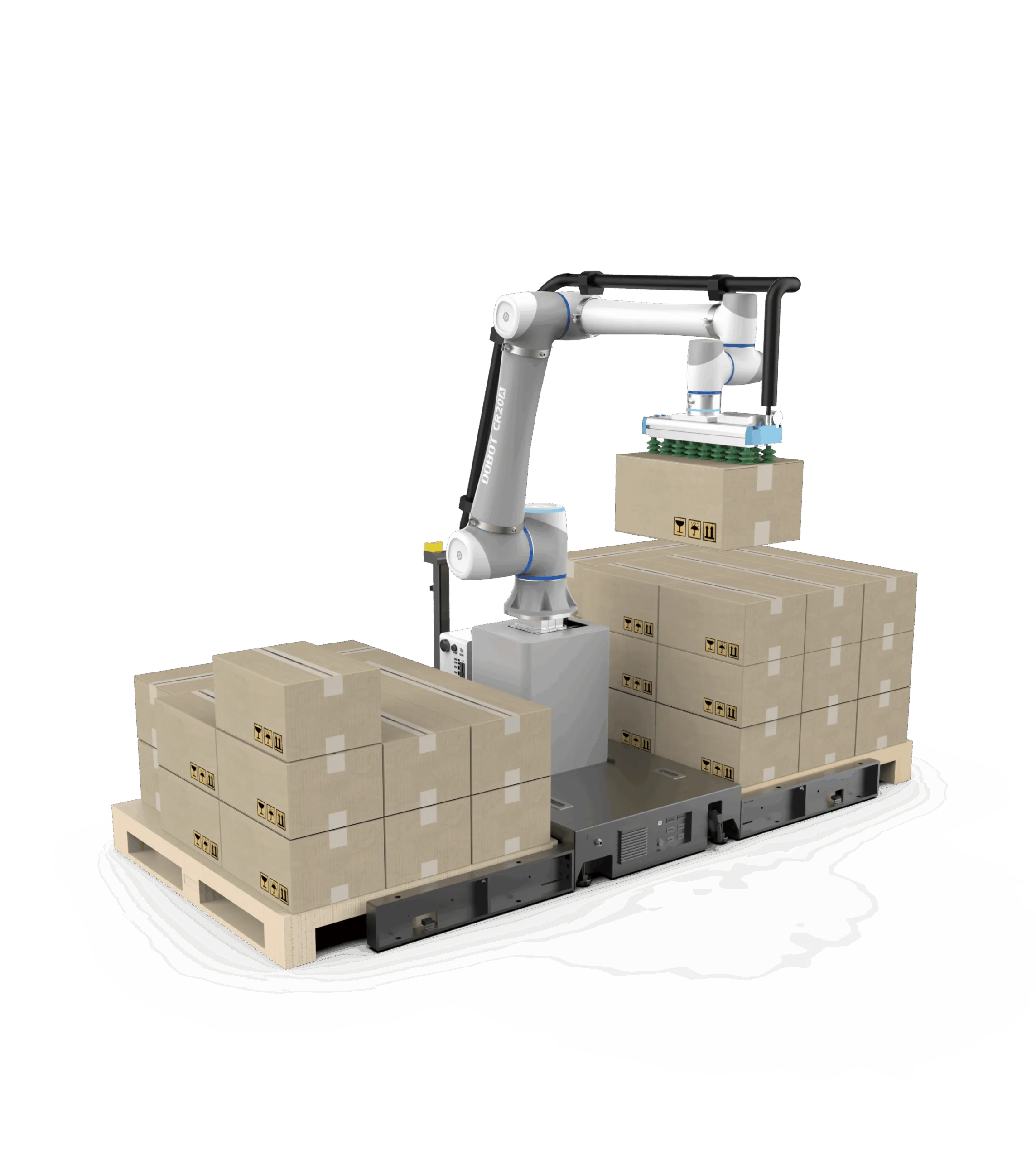
Dobot palletising solutions in APulsar catalogue
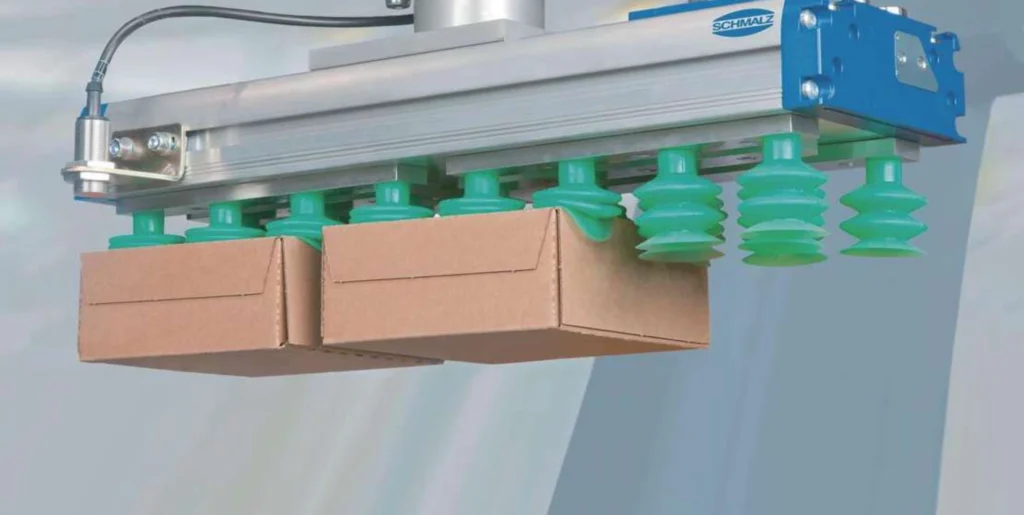
Performance Metric: In standard single-suction mode, these robots handle 8–9 boxes per minute. By utilising a dual-suction configuration (picking up two boxes at once), throughput jumps to 12–13 boxes per minute, boosting efficiency by over 60%.
The Economics of Automation: Calculating Your ROI
Investing in automation is a financial strategy designed to reduce ongoing operational expenses while locking in consistent output.
Manual palletising on a fast-moving line often requires a dedicated team of up to six people across a 24/7 schedule. By replacing that physical strain with a single cobot workstation, the payback period—the time it takes for labour savings to cover the initial cost of the robot—is typically between 8 to 10 months (or one to two years for smaller, single-shift operations).
However, the true value eliminates hidden costs:
- Turnover and Recruitment: Finding staff for “back-breaking” roles is increasingly difficult and expensive.
- Occupational Health: Lifting heavy loads hundreds of times per shift leads to chronic back strain, compensation claims, and production delays.
- Empowering the Workforce: Successful automation doesn’t mean firing your team. Businesses consistently redeploy these workers into Quality Assurance (QA) or production management tasks. You rescue them from physical degradation and elevate them into modern, technically engaging roles.
Real-World Impact Across Industries
Dobot automated solutions are actively solving bottlenecks globally:
- Food & Beverage (Juicy, Croatia): Operating in a facility with extremely limited floor space, the juice brand deployed the CR20A. The compact, fence-free design increased throughput without requiring costly facility restructuring.
- High-Volume Confectionery: A massive jelly producer handling 50 product models across 11 lines utilised the 4-step wizard for instant product changeovers. Using dual-suction, they doubled their cycle times to 10 items per minute, allowing one worker to oversee three lines simultaneously.
- Home Appliances (Huayu Electrical): Replaced rigid, caged industrial robots with 5 mobile CR20A units. Because the cobots are easily redeployed, they now use a single workstation to service two production lines at once.
- The Wine Industry (Cave de Rhodan, Switzerland): This premium winery automated their heavy carton stacking specifically to make the workplace more attractive for the next generation of workers. By offloading the physical strain, highly qualified staff were reassigned entirely to rigorous Quality Control tasks.
If you want to know more about these success stories, visit official Dobot website or YouTube channel:
Your Local Partner in Malaysia: The APulsar Advantage
While the Dobot hardware is world-class, successful automation depends entirely on expert local integration. As the official Dobot distributor in Malaysia, APulsar serves as the critical bridge between cutting-edge robotics and your specific manufacturing needs.
When it comes to palletising, APulsar’s role is highly specialised: we handle everything “after the conveyor.”
- Complete System Integration: We provide the entire ecosystem—the Dobot arm, the lifting or columnar platform, the end-effectors, and the pallet detection sensors.
- Programming and Logic: Our robotics-trained engineers run the Dobot Process Package to perfectly configure your specific stacking patterns and trajectory paths.
- Feasibility and Simulation: Before a single piece of hardware is moved into your facility, we use Dobot’s 3D simulation platform to validate your exact layout and definitively calculate your expected ROI.
- Long-Term Commitment: APulsar secures your investment with a comprehensive 15-month warranty (a 3-month system check followed by a full year of coverage). To ensure 24/7 reliability, we also execute professional maintenance on your robotic setup once a year.
Summary
Automating your end-of-line packaging is the most effective way to eliminate physical strain, recover warehouse space, and drastically increase your operational efficiency. With Dobot’s collaborative technology and APulsar’s dedicated engineering support, transitioning to a modern, automated facility is a seamless and highly profitable reality.
Get in touch!
Reach out to APulsar today to secure these Dobot products at special prices. Our team in Petaling Jaya is ready to assist you with fast delivery across Malaysia.
And if you would like to see more product news like this one, don’t forget to subscribe to our newsletter below!