
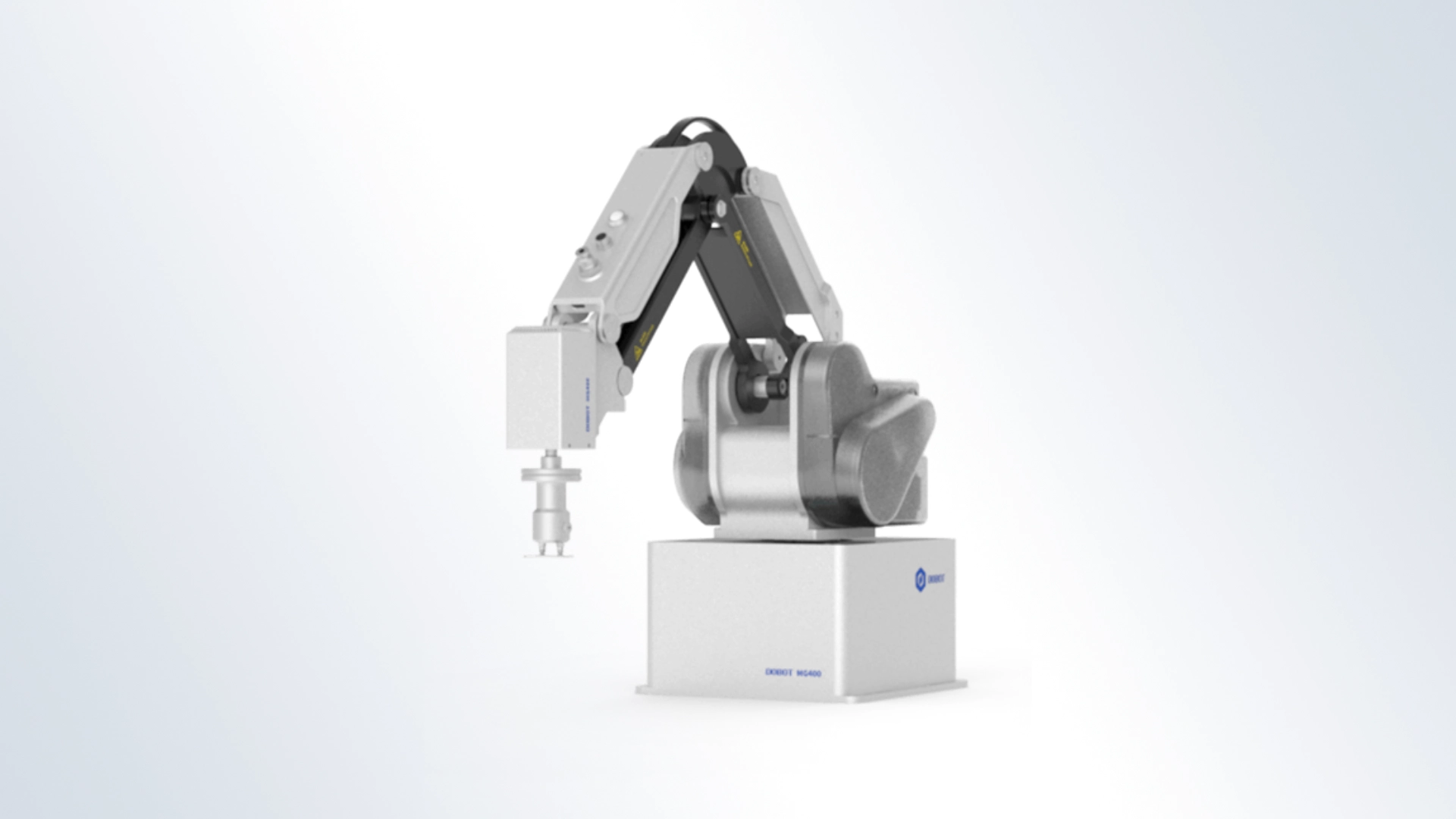
In this article, we will review the Dobot MG400 — a basic desktop 4-axis robot that stands out from the crowd. Unlike other machines in this category, the MG400 is classified as a Collaborative Robot (Cobot) rather than a traditional SCARA robot.
You will find out what makes the Dobot MG400 so special, how its engineering limits work, how you can get its full price back in just 3 to 6 months, and how a small, basic model can become your risk-free gateway into the world of industrial automation.
What Makes the MG400 a "Cobot"?
Dobot Robotics offers a wide range of collaborative arms, most of which are 6-axis machines. The MG400 is a bit different. It is a 4-axis robot, meaning it can move in XYZ coordinates and perform Theta rotation. Usually, 4-axis robots fall into the category of SCARA (Selective Compliance Assembly Robot Arm). However, we firmly classify the MG400 as a Collaborative Robot.
Why? Because it inherits the defining safety feature of its larger siblings in the CR/CRA series: collision detection.
A traditional SCARA robot is fast, rigid, and blind; if it hits something, it causes an accident. The MG400, on the other hand, stops immediately if it detects a gentle collision with any object or human. This makes it inherently safe to operate alongside your staff without expensive safety cages.
Because it is safe, its primary goal is not to replace your human workforce, but to collaborate with them. We use cobots to free precious technicians from mind-numbing, repetitive tasks. By automating the drudgery, you can assign your technicians to more demanding, purposeful operations that require actual human cognition and bring more value to the company.
The Financials: A 3 to 6-Month ROI
The MG400 is an ideal entry point into production robotics simply because of the math. The market price for one unit without any discounts is around RM15,000. For comparison, a typical industrial SCARA robot costs between RM30,000 and RM100,000, not including the required safety peripherals.
You can essentially get your first collaborative robot for the price of a professional laptop. At this price point, you can treat it as a trial: buy it, test it in different scenarios, and if it doesn’t fit your current process, you simply store it until your next idea. Trying this with a RM100,000 machine is a massive financial risk; with the MG400, it’s just an experiment.
So, how do we calculate a 3 to 6-month Return on Investment (ROI)?
Imagine you have a process where an operator’s sole job is to pick, place, and arrange trays for 3 hours a day, before moving to other tasks. The MG400 can easily take over those 60+ hours of simple operations per month. Furthermore, a robot doesn’t sleep — it can work all three shifts, providing 180+ hours of labor per month for the price of two flagship smartphones. If you take the hourly rate of your production line (including employer contributions), the RM15,000 investment pays for itself incredibly fast.
More importantly, it shifts your technicians away from the physical strain of repetitive tasks, allowing you to reallocate those paid hours toward quality control, machine supervision, or tasks that actually require a human brain.
Primary Applications for MG400
We should be clear: the MG400 is not as fast or as surgically accurate as a premium SCARA robot. But for a lot of small production processes, you simply do not need that level of over-engineered performance. Dobot released the MG400 specifically for the “low-hanging fruit” of manufacturing:
Basic Pick and Place
Moving small, light objects from one station to another (e.g., loading a machine or arranging parts on a conveyor).
Because it is a 4-axis machine, some complex setups might require two MG400s to complete a task. Fortunately, the low price makes dual-robot setups highly affordable.
Visual Inspection
The robot can be integrated with 3rd-party cameras to automate quality control. This works in two ways:
- Moving the part: The robot picks up the manufactured item and presents it to a fixed, high-definition camera.
- Moving the camera: A camera is mounted directly onto the robot’s arm. The robot moves the camera around a static object (like a smartphone chassis), taking multipoint pictures from different angles to check for cracks, dust, or alignment issues.
(Note: While camera hardware is simple, inspection software is complex. APulsar works with various specialized partners to ensure the vision software matches your specific quality control needs.)
Engineering Physics: Payload and Reliability
In terms of reliability, the MG400 is rated for a massive 20,000 hours MTBF (Mean Time Between Failures). However, reaching this lifespan requires understanding its physical limits.
The robot is rated for a maximum payload of 500 grams. The most critical thing to remember is that this limit includes the weight of the gripper. If you install a custom gripper that weighs 300g, the robot can only safely pick up a 200g object.
To maximize the lifespan of the machine, you must also manage inertia and leverage:
- Inertia: If you are carrying the absolute maximum weight (e.g., 490g total) and moving the arm at its maximum speed, the sudden stop at the end of the movement creates high inertia. This briefly pushes the actual force beyond 500g, which degrades the motors over time.
- Central vs. Non-Central Loads: If the robot picks up an item directly through its center of gravity, the load is balanced. But if you use an elongated extension to pick up an item off-center, you create a lever. This non-central load applies torque to the robot’s joints, increasing wear and tear.
Staying below maximum speeds when carrying heavy loads, and keeping the load centralized, guarantees a highly reliable machine.
Warranty, Integration, and Service Support
When you purchase an MG400 through APulsar, you receive a 15-month warranty (factoring in roughly 3 months for setup, plus a full year of operational warranty).
As an official Dobot distributor, APulsar handles the initial setup and programming. Because real-world projects often involve other moving parts like conveyors or vibrating bowls, we actively cooperate with system integration partners. We handle the robotics; they handle the wider factory ecosystem.
Once the initial installation is tested and bought off by the customer, APulsar provides ongoing support in three ways:
- Troubleshooting: If the robot suddenly malfunctions or deviates from the agreed-upon, programmed plan, we will come and fix the bug for free.
- Upgrades & Changes: If you introduce a new product model to the line, or want to completely change the robot’s sequence, this is treated as a new, chargeable modification (much like returning to a dealership to add aftermarket parts to your car).
- Knowledge Transfer: We can train your in-house engineers so they can maintain, tweak, and reprogram the robot themselves, keeping your future maintenance costs at zero.
Core Technical Specifications of Dobot MG400
Dobot MG400 Specifications
| Specification | Details | |
|---|---|---|
| Number of Axes | 4 | |
| Payload | 500 g (Max. 750 g) | |
| Working Radius | 440 mm | |
| Repeatability | ±0.05 mm | |
| Range of Motion | J1 | ±160° |
| J2 | -25°~85° | |
| J3 | -25°~105° | |
| J4 | ±360° | |
| Maximum Joint Speed | J1 | 300° /s |
| J2 | 300° /s | |
| J3 | 300° /s | |
| J4 | 300° /s | |
| Power | 100~240V AC, 50/60 Hz | |
| Rated Voltage | 48V | |
| Power Consumption | 150W | |
| Communication Interface | TCP/IP, Modbus TCP | |
| Installation | Desktop | |
| Weight | 8 kg | |
| Base Size | 190 mm × 190 mm | |
| Environment | 0° ~ 40° C | |
You can find all required information for the Dobot MG400, including related case studies, directly on the Dobot official website.
Dobot MG400 Review: Summary
The Dobot MG400 isn’t meant to be the most powerful robot on the market. It is meant to be the smartest, most cost-effective first step a factory can take toward a fully automated future.
For more information about Dobot MG400, please click here.
Get in touch!
The APulsar team hopes that this article has been insightful for you. Anytime you need advice, assistance, or technical support — just contact us.
And if you would like to see more useful guides like this one, don’t forget to subscribe to our newsletter below!

This is the heading
Lorem ipsum dolor sit amet, consectetur adipiscing elit. Ut elit tellus, luctus nec ullamcorper mattis, pulvinar dapibus leo.