
Solar energy is a concept familiar to almost everyone. You install panels on a roof, they soak up the sun, and your electricity bill goes down. But have you ever thought about how that energy actually travels from a glass panel to the plug in your wall?
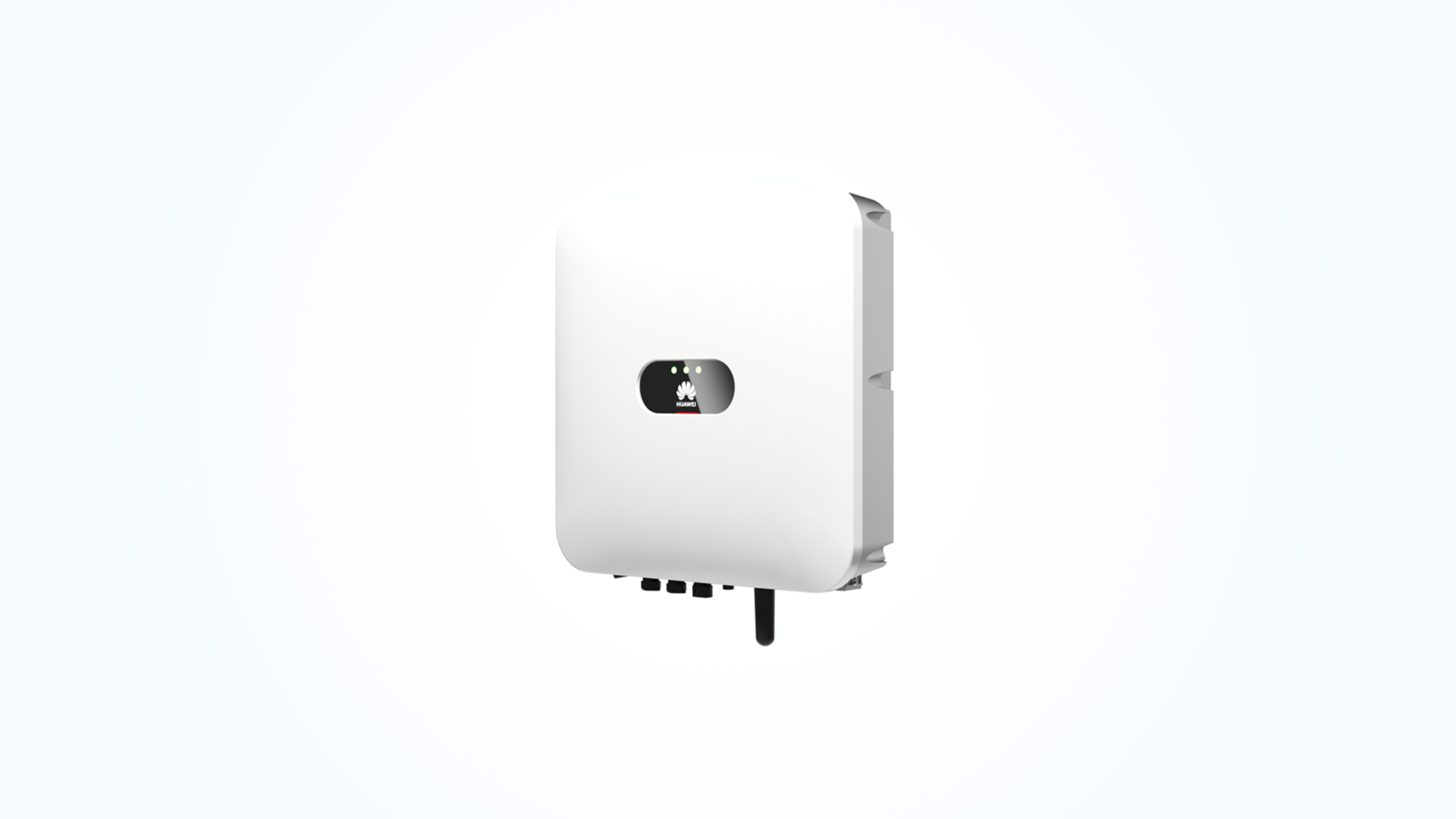
You can’t just plug your television directly into a solar panel. The raw energy generated on your roof is entirely incompatible with the appliances in your house. For a solar energy system to work, it relies on a critical intermediate device: the solar inverter.
In this comprehensive guide, we will break down exactly how solar inverters work, the technical functions they perform behind the scenes, and how to choose the right one for your specific needs.
How is a Solar Energy System Organised?
Before diving into the inverter itself, it helps to understand the full chain of command in a standard solar energy setup. Power travels through several stages before it powers your home:
- Solar Panels (The Harvesters): Photovoltaic cells capture sunlight and convert it into raw electrical energy.
- Power Optimisers (The Regulators – Optional): Small devices attached to the panels that condition the electricity and maximize output, especially if part of the roof is shaded.
- Solar Inverter (The Brain): The central hub that takes the raw electricity and translates it into a usable format.
- Electrical Panel / Breaker Box (The Distributor): Routes the usable electricity to your home’s various circuits, outlets, and appliances.
- The Grid or Battery (The Backup): Any excess power your home doesn’t use is either sent outward to the utility grid or stored locally in a physical battery system for nighttime use.
- Meter / Net Meter (The Tracker): Measures how much electricity your system sends to the grid and how much electricity your home draws from the grid. In grid-tied systems, this is usually a bi-directional meter.
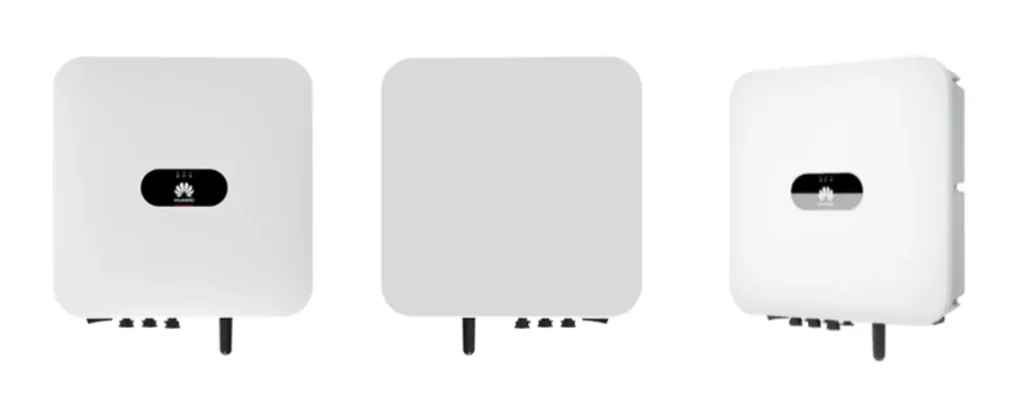
The SUN2000 is an example of a Huawei residential solar inverter featured in APulsar’s online product catalogue. Click here to learn more.
The Core Role of a Solar Inverter
To understand why an inverter is mandatory, it helps to use a couple of simple analogies.
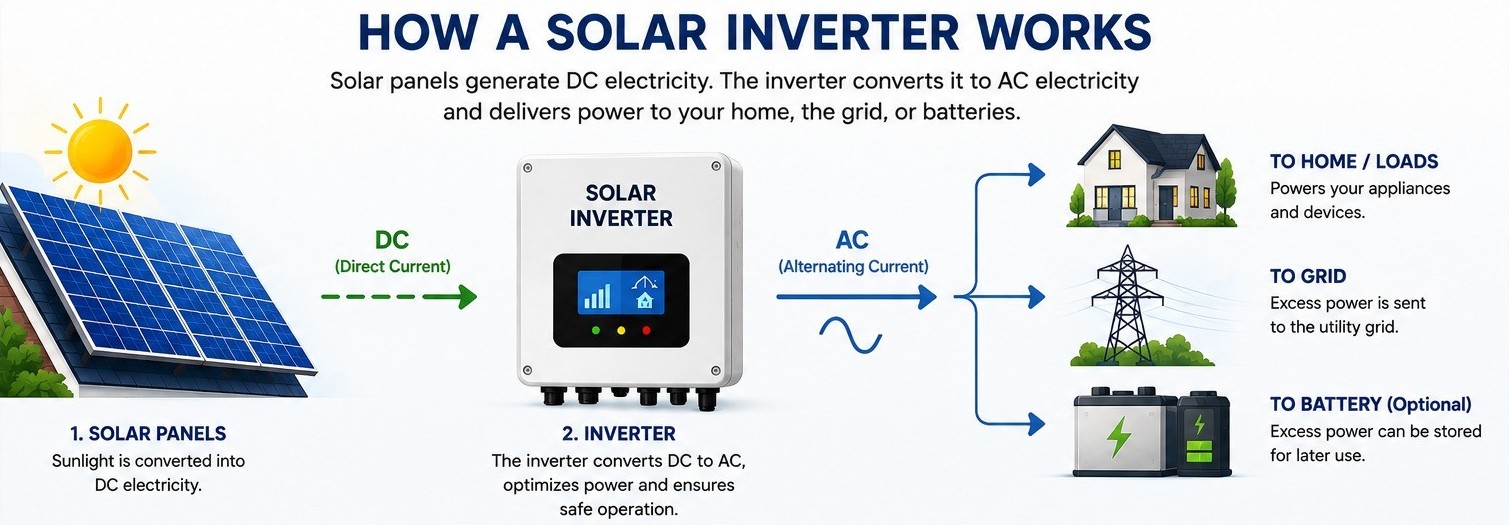
Think of your solar panels as a heavy-duty water pump pulling liquid up from a muddy well. The water coming up is raw and unfiltered; you certainly can’t drink it straight from your kitchen tap. You need a treatment system first. A solar inverter is exactly that treatment system, but for electricity—processing and purifying the raw power so it is safe for your home.
More technically, it comes down to the difference between DC and AC power:
- Direct Current (DC): Solar panels produce DC electricity. This is power that flows in one steady, continuous direction.
- Alternating Current (AC): Your home and the utility grid run on AC electricity, which rapidly pulses back and forth (alternates) dozens of times per second. Your refrigerator, microwave, laptop charger, and lights all require AC power.
Imagine your solar panel is a foreign language speaker who only speaks “DC,” while your house only understands “AC.” The inverter acts as the real-time interpreter standing between them, translating the electrical current instantly so the system operates in perfect harmony.
A Quick Note on Optimisers: Inverters should not be confused with power optimizers. While an inverter translates DC to AC, an optimizer simply conditions the DC electricity before it ever reaches the inverter to ensure shade on one panel doesn’t ruin the output of the whole system. We will explore optimisers in depth in a separate article.
4 key functions of solar inverter:
Modern inverters do much more than just flip DC to AC. They are highly sophisticated computers that manage the entire health of your solar array. Here are their four primary functions:
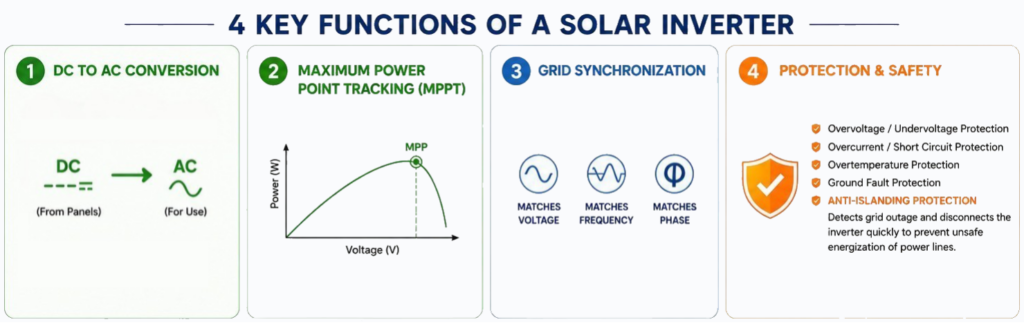
- DC to AC Conversion
This is the foundational job. The inverter takes the one-directional DC voltage generated by the panels and runs it through internal circuitry to output a clean, oscillating AC voltage that household appliances can use safely. - Maximum Power Point Tracking (MPPT)
Sunlight intensity and panel temperatures are constantly changing throughout the day. An inverter utilizes MPPT technology—a digital algorithm that continuously tracks the voltage and current curve of the solar panels. By constantly adjusting the electrical load, the inverter ensures the panels are continually operating at their absolute maximum efficiency, extracting every possible drop of energy. - Grid Synchronization
If your solar setup is tied to the local utility grid, you cannot simply dump raw power into city power lines. The inverter precisely synchronizes its AC output to match the exact voltage, frequency, and phase of the local grid. This ensures a perfectly smooth, stable transfer of excess power without disrupting local utility infrastructure. - Protection and Safety
The inverter acts as the system’s bodyguard. It is packed with built-in safety features to protect your appliances and the grid, including overvoltage, short circuit, and overtemperature protections. Crucially, it features Anti-Islanding Protection. If the city grid goes down during a blackout, the inverter instantly detects the outage and disconnects itself. This prevents your solar panels from pumping live electricity into dead neighborhood power lines, which could severely injure utility workers trying to fix the outage.
4 Types of Solar Inverters
Not all installations are the same, and the industry has developed different inverter topologies to solve different engineering challenges.
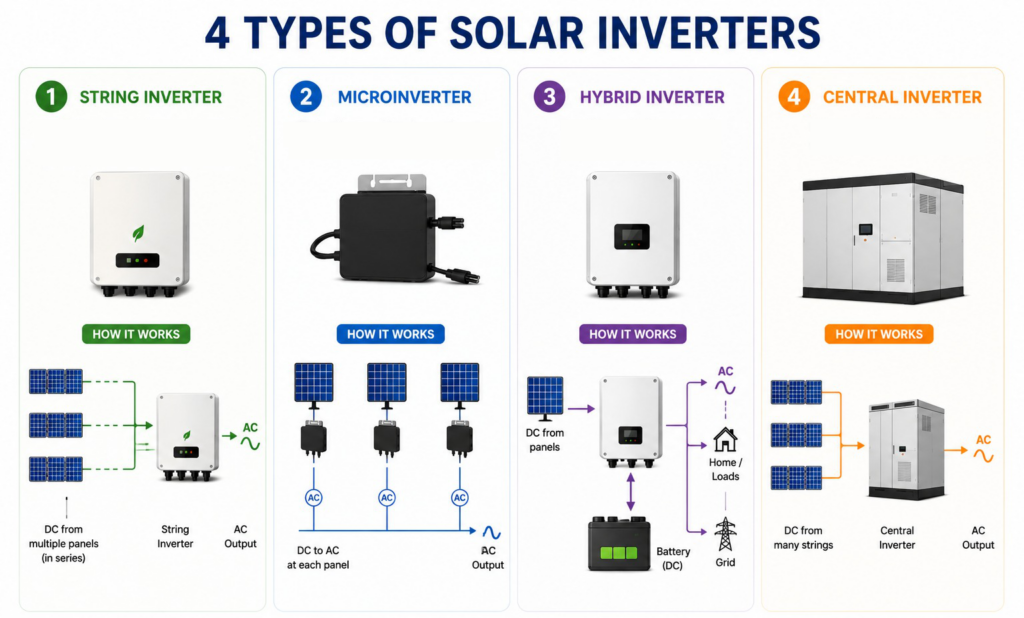
1. String Inverter
This is the most common and cost-effective standard. Multiple solar panels are wired together in a series (a “string”). The combined DC power from all these panels is sent down to a single, centralized string inverter mounted on the side of the house.
• How it works: All panels share a single MPPT.
• The Catch: Because they are linked in a series, if one panel is covered by shade, the power output of the entire string drops to match the weakest link.
• Best for: Roofs with large, unobstructed surface areas facing a single direction.
2. Microinverter
Instead of one large box on the wall, microinverters are miniaturized units mounted directly onto the back of each individual solar panel.
• How it works: The DC-to-AC conversion happens right there on the roof. Every single panel gets its own dedicated MPPT.
• The Benefit: Power production is completely independent. If one panel is covered in shade or dirt, the rest of the array continues operating at 100% capacity.
• Best for: Complex roofs with multiple angles, or properties that experience partial shading from trees or chimneys.
3. Hybrid Inverter
A hybrid inverter is a multi-tasking powerhouse that combines a solar inverter and a battery management system into one unit.
• How it works: It intelligently directs traffic. It can take DC power from the panels and convert it to AC for the house, send DC power directly into a battery for storage, or draw power out of the battery to power the house at night.
• Best for: Anyone planning to install battery storage (like a Tesla Powerwall) for blackout protection or off-grid independence. (Note: You must ensure the hybrid inverter is compatible with your specific brand of battery).
4. Central Inverter
Think of a central inverter as a string inverter built for heavy industry. It consolidates power from dozens or hundreds of different strings.
- How it works: Massive power ratings ranging from 250kW up to several Megawatts.
- Best for: Large-scale commercial applications, industrial facilities, and utility-scale solar farms.
How to Choose the Right One for Your Home
Selecting the right inverter requires careful planning. Here are five technical considerations to keep in mind:
- Know Your Energy Usage: Audit your recent electricity bills. You need to understand your daily kilowatt-hour (kWh) consumption so your system can be scaled to match your actual lifestyle.
- Choose the Right Size: The inverter’s capacity must strictly align with the total output of your solar panels. An inverter that is drastically undersized will “clip” (waste) power, while one that is wildly oversized will operate inefficiently.
- Check the Efficiency Rating: Look for inverters with high conversion efficiency ratings (typically 95% to 98%). The higher the efficiency, the less power is lost as heat during the DC-to-AC conversion process.
Verify Compatibility: Ensure the inverter plays nicely with the rest of your intended hardware, particularly if you are considering adding physical battery storage down the line.
Summary
Solar panels may capture the sun’s raw energy, but they are completely useless without an inverter to translate that power into a usable format. From executing the vital DC-to-AC conversion to continuously tracking peak performance via MPPT, the inverter is the true heartbeat of any solar installation.
Whether you opt for a standard string inverter for an unobstructed roof or a highly independent microinverter setup for a complex layout, understanding how these devices operate puts you in the driver’s seat, allowing you to extract the maximum possible return on your solar investment.
FAQ
Frequently Asked Questions
Can solar panels work without an inverter?
Technically yes, but only if you are powering devices that specifically use Direct Current (DC), like specialized RV or marine equipment. However, you cannot simply wire a device directly to a solar panel. Raw solar power is incredibly inconsistent; as sunlight fluctuates throughout the day, the voltage spikes and drops erratically. If you send this unfiltered electricity directly into an appliance, those power surges will severely damage or instantly destroy the electronics (with some exceptions like a very basic, old-school incandescent light bulb).
To safely power DC devices without an inverter, you must use an intermediate device either a Solar Charge Controller or Dc- DC regulator. This acts like an electrical shock absorber, taking the erratic raw DC power from the panels and flattening it out into a smooth, constant voltage. So, while you can skip the inverter for a purely off-grid DIY setup, you still need a intermediate device to protect your gear and for standard AC household appliances, an inverter remains mandatory.
Should I get a bigger inverter "just in case"?
For a grid-tied PV system, it is common to size the DC solar array slightly larger than the inverter’s AC output capacity, typically with a DC/AC ratio of about 1.1 to 1.3. This means the panels are rated higher than the inverter, which helps improve inverter utilization without causing excessive clipping. Choosing a much larger AC inverter “just in case” is usually not economical, because the inverter may be underutilized most of the time. It only makes sense if future expansion is planned very soon and the inverter’s MPPT voltage, current, and input limits can support the additional panels.
For a small future expansion, it may be possible to use the same inverter, as long as the expanded array still stays within the inverter’s allowed DC/AC ratio, MPPT voltage range, maximum input current, and string design limits. if the future expansion is large but not planned anytime soon, it is often better to add another inverter later rather than oversizing the inverter from the start.
Do I need a power optimizer if I already have a good inverter?
Not always. If your roof is completely unobstructed and faces one direction, a standard string inverter is fine. However, if your roof experiences intermittent shading from trees, neighbouring buildings, or chimneys, power optimizers are highly recommended. They ensure that temporary shade on one panel doesn’t bottleneck the power generation of the entire array.
How long does a solar inverter last?
Most standard string inverters have a lifespan of 10 to 15 years. Microinverters and power optimizers, however, often carry warranties lasting 20 to 25 years. Because the lifespan of a central string inverter is generally shorter than the solar panels themselves (which can last 25+ years), you should factor the cost of one future inverter replacement into your system’s long-term financial calculations.
Get in touch!
The APulsar team hopes that this article has been insightful for you. Anytime you need advice, assistance, or technical support — just contact us.
And if you would like to see more useful guides like this one, don’t forget to subscribe to our newsletter below!

This is the heading
Lorem ipsum dolor sit amet, consectetur adipiscing elit. Ut elit tellus, luctus nec ullamcorper mattis, pulvinar dapibus leo.