
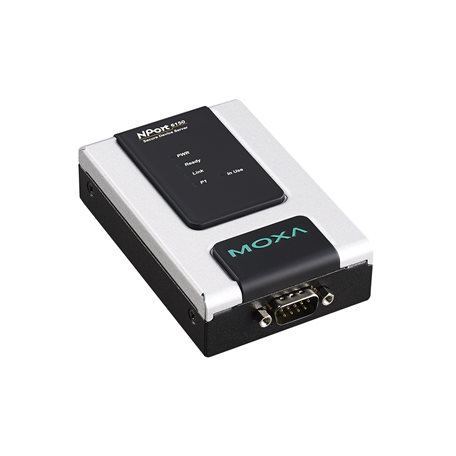
1/2-port RS-232/422/485 secure terminal servers
Click “WhatsApp Us” or “Get a Quote” above to buy NPort 6100/6200 Series from APulsar Technologies, MOXA official distributor.
Purchase walk-in from our office in Petaling Jaya, or order online and enjoy fast delivery across Kuala Lumpur and the entire Malaysia.
The NPort® 6000 device servers use the TLS and SSH protocols to transmit encrypted serial data over Ethernet. The NPort® 6000’s 3-in-1 serial port supports RS-232, RS-422, and RS-485, with the interface selected from an easy-to-access configuration menu. The NPort® 6000 2-port device servers are available for connecting to a 10/100BaseT(X) copper Ethernet or 100BaseT(X) fiber network. Both single-mode and multi-mode fiber are supported.
For many applications, guaranteeing secure data transmission is an important concern when connecting serial devices to a network. To answer this concern, the NPort® 6000 supports the TLS and SSH protocols, which work by encrypting data before sending it over the network. With the NPort® 6000, users can rest assured that serial data is transmitted securely over both private and public networks.
The NPort® 6250 device servers help guarantee reliability by providing users with secure serial-to-Ethernet data transmission and a customer-oriented hardware design. If the Ethernet connection fails, the NPort® 6250 will queue all serial data in its internal 64 KB port buffer. When the Ethernet connection is re-established, the NPort® 6250 will immediately release all of the data in the buffer in the order that it was received. Users can increase the port buffer size by installing an SD card.
| 100BaseFX | ||||
| Multi-Mode | Single-Mode | |||
| Fiber Cable Type | OM1 | 50/125 µm | G.652 | |
| 800 MHz x km | ||||
| Typical Distance | 4 km | 5 km | 40 km | |
| Wavelength | Typical (nm) | 1300 | 1310 | |
| TX Range (nm) | 1260 to 1360 | 1280 to 1340 | ||
| RX Range (nm) | 1100 to 1600 | 1100 to 1600 | ||
| Optical Power | TX Range (dBm) | -10 to -20 | 0 to -5 | |
| RX Range (dBm) | -3 to -32 | -3 to -34 | ||
| Link Budget (dB) | 12 | 29 | ||
| Dispersion Penalty (dB) | 3 | 1 | ||
| Note: When connecting a single-mode fiber transceiver, we recommend using an attenuator to prevent damage caused by excessive optical power. Note: Compute the “typical distance” of a specific fiber transceiver as follows: Link budget (dB) > dispersion penalty (dB) + total link loss (dB). |
||||
Apulsar.com uses cookies to ensure you get the best experience. By continuing to browse, you agree to our use of cookies. Our privacy policy available here